A few weeks ago, I was scrolling through LinkedIn during my morning coffee, and I noticed something that has stuck with me ever since.
A medical aesthetics company I follow had posted from its corporate page. Polished. On-brand. Probably approved by three people. It got 12 likes.
Right below it, one of their nurse injectors had posted a short video walking through her favorite part of the workday. No production value. Just her, in scrubs, talking about why she loves what she does. It had over 4,000 likes and a comment thread full of prospective patients asking how to book.
Same company. Same week. Same audience. Wildly different results.
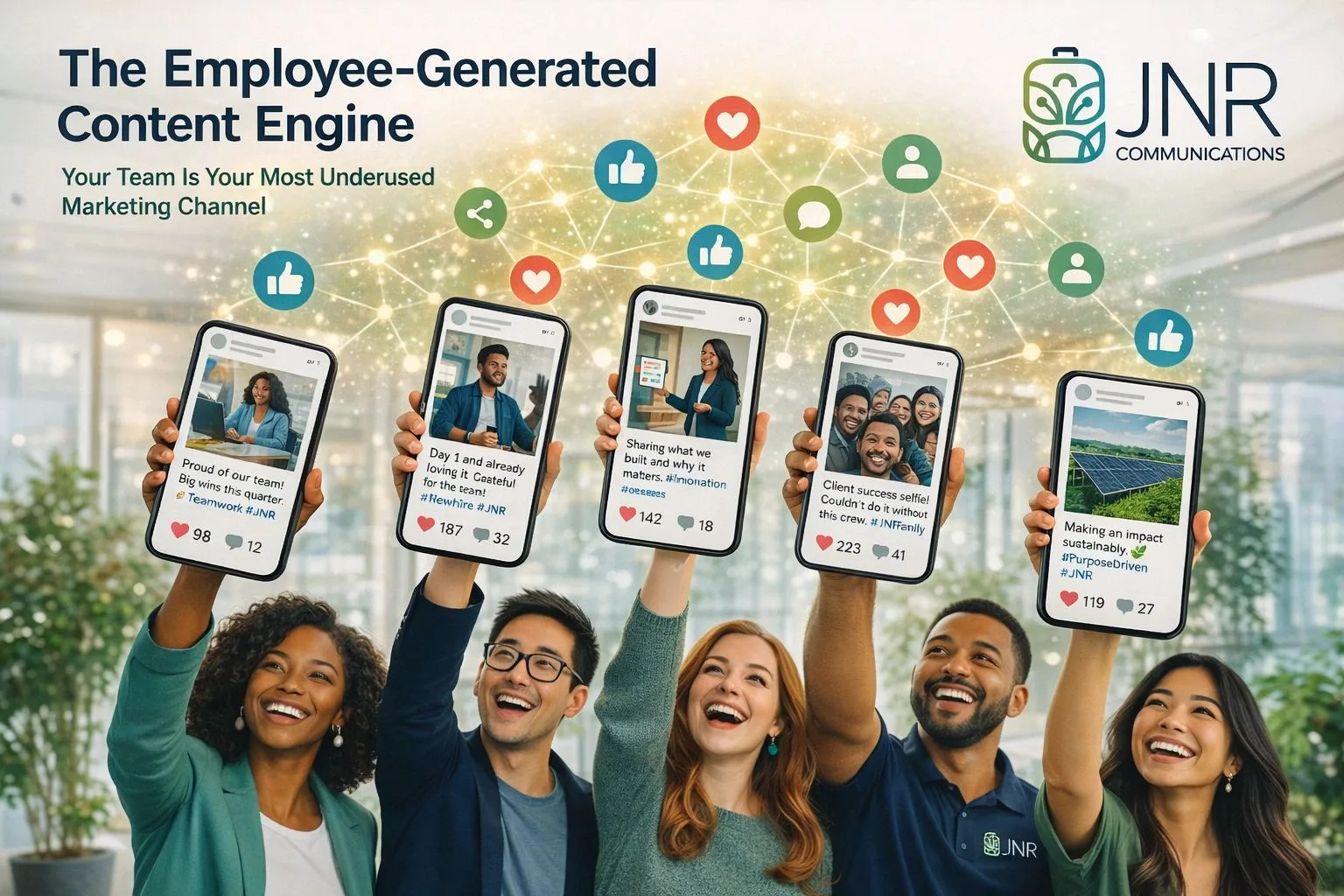
This is not a fluke. It is the new reality of how LinkedIn, and frankly most social platforms, distribute content. The algorithm has decided that real humans outperform brand logos, and the data backs that up. People want to hear from people. And the most underused marketing asset sitting inside almost every business right now is the team that already works there.
Welcome to the world of Employee-Generated Content, or EGC. And if your team is not part of your marketing engine yet, you are leaving an enormous amount of reach, trust, and qualified leads on the table.
Why LinkedIn Is Quietly Demoting Your Brand Page
Let me share a stat that should change how you think about social strategy. Posts from individual employees consistently generate roughly eight times more engagement than the same content shared by a company page. Even more telling, content shared by employees gets reshared dramatically more often than what comes from the brand account.
Why? A few reasons worth understanding.
First, the platforms have algorithmic preferences. LinkedIn in particular has been transparent that it favors content that creates conversation, and conversations happen between humans, not between humans and logos. When your VP of operations posts a thoughtful take on a trade show, the algorithm reads that as a person sharing a perspective. When your brand account posts the same thing, it reads as marketing.
Second, trust dynamics have shifted. Most consumers say they trust regular employees more than they trust the CEO or the official company communications. That is a fundamental change in how authority works online. The face of your brand is no longer your logo. It is your people.
Third, networks compound. Your company page might have 5,000 followers. Your team of 20 employees might collectively reach ten times that audience, and those audiences are warmer because they already know and trust the person doing the sharing.
This is the relationship infrastructure I talk about all the time. Your employees are nodes in a network that is far larger than your owned channels will ever be. The question is whether you are activating that network or ignoring it.
What Most EGC Programs Get Wrong
Before I share what works, let me name what does not. Because most EGC efforts I see crash and burn for the same predictable reasons.
They feel forced.
The classic mistake is the corporate Slack message that says, please share this post on your LinkedIn today. Employees do it once, reluctantly, and never again. Worse, their networks can smell the inauthenticity from a mile away. Engagement craters.
They are too compliance-heavy.
On the opposite end, some companies build EGC programs that require legal review of every post, brand approval on every photo, and a 14-page social media policy. By the time an employee gets through that gauntlet, the cultural moment has passed and so has their motivation.
They reward the wrong thing.
When companies tie EGC to performance reviews or financial bonuses, the content shifts from authentic to performative. People post for the metric, not for the message. You can spot that kind of content immediately, and so can your audience.
They have no support system.
Most employees are not professional content creators. Asking them to just post more without giving them ideas, examples, or coaching is setting them up to fail. Then leadership concludes that nobody wants to participate, when the real issue is that nobody knew how.
A good EGC program solves all four problems at once. Here is how.
The Five-Part EGC Roadmap
Over the years, I have helped clients build content programs that use the entire team as an amplification engine. The framework that consistently works has five parts.
1. Start with the willing, not the whole company.
Identify three to five employees who already have an active social presence or who genuinely want to build one. These are your founding members. Their job is not to push corporate messaging. Their job is to share their authentic professional perspective in a way that happens to align with what your brand cares about.
Resist the temptation to mandate participation across the entire team. EGC works because it is voluntary and authentic. The moment it becomes a job requirement, it stops working.
2. Build a content menu, not a content calendar.
Instead of telling employees what to post on which day, give them an ongoing menu of ideas they can pull from when inspiration is low. Behind-the-scenes moments. Lessons learned from a recent project. A reaction to industry news. A question they get from clients all the time. Their take on a conference they attended.
The menu approach respects that your employees have full-time jobs and creative ebbs and flows. It makes participation easy without making it prescriptive.
3. Create simple, lightweight guardrails.
You do need some guardrails, especially in regulated industries like medical aesthetics or healthcare. But they should fit on one page, not in a binder. Things like: do not share patient information, do not make medical claims you cannot back up, tag the company when relevant, and reach out if anything ever feels uncertain.
Guardrails protect everyone. Bureaucracy protects no one.
4. Provide coaching, not scripts.
This is where most programs underinvest. Bring in someone, internal or external, who can sit down with your team for an hour and teach them how to write a hook, how to structure a post for skimmability, how to engage in comments without sounding like a robot. The skill compounds. Once your team understands what good looks like, the quality of everything they post improves permanently.
5. Celebrate publicly and often.
When an employee post does well, recognize it in your team meeting. Share the impact. Show the rest of the company what is possible. This creates a positive social loop where participation feels like a win rather than a chore. The Givers Gain principle applies inside your company too. When you give your team recognition for showing up, they keep showing up.
How JNR Builds EGC Programs That Actually Stick
This is where I want to be straightforward about what we do at JNR Communications, because EGC is one of the areas where having a partner makes a real difference.
Most businesses I talk to fall into one of two camps. Either they have never thought systematically about employee advocacy, or they tried it once and concluded it does not work. Both situations are fixable, and both are exactly what we help with.
Our approach is built on the same principles that guide everything else we do: relationships first, strategy second, tactics third. We work with our clients in beauty, wellness, medical aesthetics, and medical devices to identify the right founding members of an EGC program, develop a content menu that fits the business, draft simple guardrails that protect without restricting, and coach the team on how to write content that actually performs.
And because Jennifer Rice has spent nearly three decades building media relationships, we are also able to bridge employee content into earned media opportunities. A nurse injector who posts consistently and thoughtfully on LinkedIn becomes a credible source for a beauty publication. A medical device executive who shares insightful posts becomes a go-to expert for industry journalists. EGC and earned media are not separate channels. They feed each other.
The compounding effect is significant. A team of ten engaged employees, posting one to two times a week with coaching, can generate the kind of cumulative reach and trust that would cost six figures to buy through paid media. And because the content is authentic, the leads it generates are warmer and the relationships go deeper.
Your Team Is Already Online. The Question Is How.
Here is the thing nobody likes to admit. Your employees are already on LinkedIn, Instagram and Facebook. They are already posting. The only question is whether they are posting in ways that build your brand or in ways that have no connection to it at all.
An EGC program is simply a way of channeling that existing energy in a direction that benefits everyone, including the employees themselves, who often build their own personal brands and career capital through the process.
This is what relationship infrastructure looks like in 2026. Not a single corporate megaphone shouting into the feed, but a network of trusted human voices building credibility together.
Your team is your most underused marketing channel. Let's change that.
Ready to Activate Your Team as a Marketing Engine?
JNR Communications helps medical aesthetics, beauty, wellness and CPG brands build employee-generated content programs that feel authentic, perform consistently, and complement traditional earned media. Let's talk about what an EGC engine could look like inside your company.
✉️ Greg@JNRcommunications.com
🌐 JNRcommunications.com