A few years ago I watched a business celebrate a video that hit one million views.
One million. The team was thrilled. Screenshots went in the group chat. Someone said the word "viral" out loud with a straight face.
Six weeks later I asked how many consultations came out of it.
The answer was four. Not four hundred. Four. And two of those were people asking whether the practice was hiring.
I want to be clear that nobody did anything wrong. The video was good. The audience was real. The views were not bought. It just turned out that two million people watching you is not the same thing as two million people trusting you, and in a business where someone is handing you their face, their health, or their money, only one of those two things pays the bills.
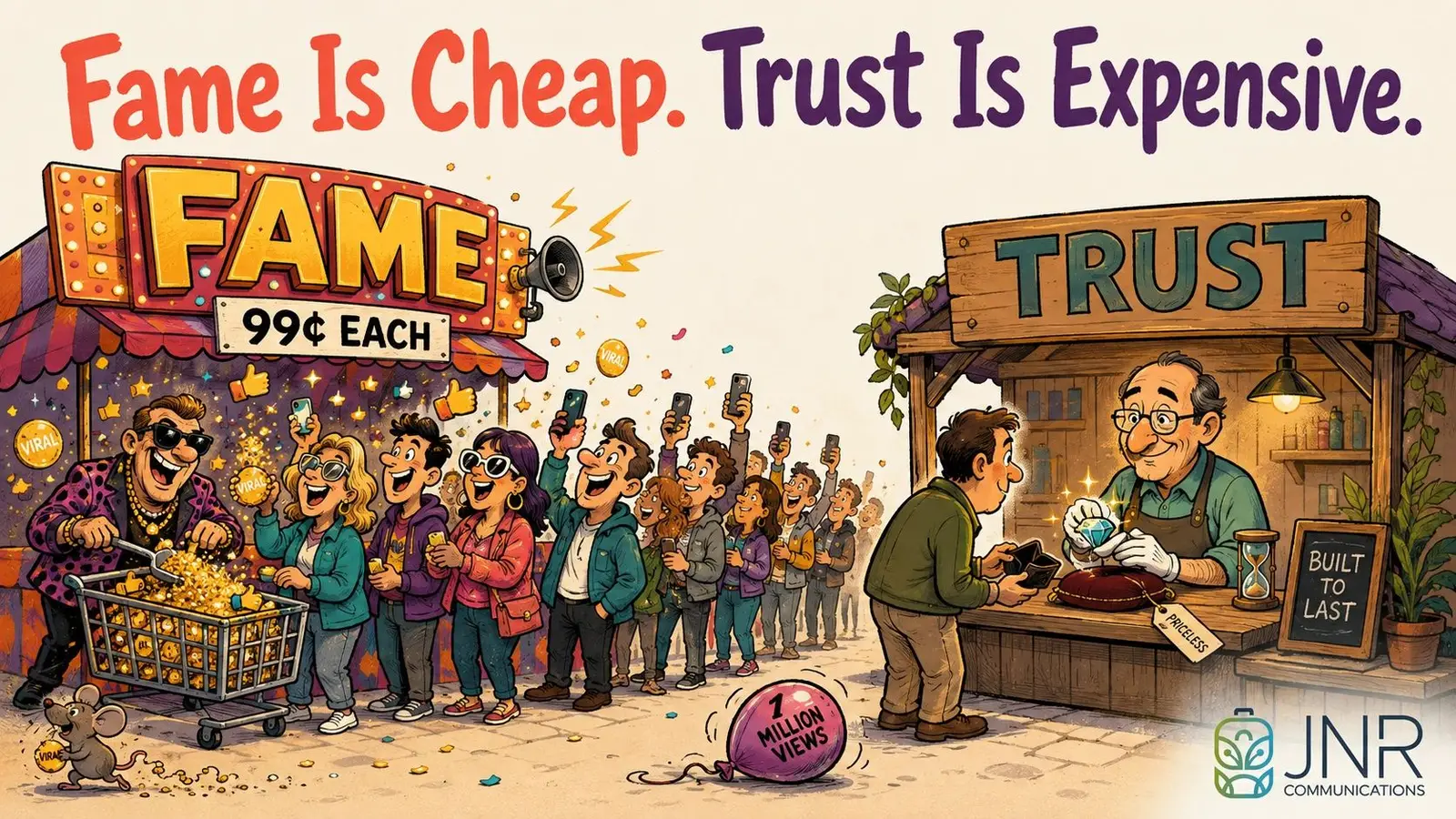
That gap is the whole subject of this post. Because attention has gotten cheaper every single year of my career, and trust has gotten more expensive every single year of my career, and most marketing budgets are still built as though the opposite were true.
Fame Got Cheap. Here Is Why.
Twenty years ago, getting a million people to look at you required gatekeepers. You needed a television segment, a magazine placement, a billboard budget, or a stroke of luck so rare it became a company legend. Attention was scarce because distribution was scarce.
That world is gone. Now anyone with a phone can reach a million strangers before lunch, and the platforms are actively looking for reasons to hand out that reach. Algorithms reward novelty, volume, and emotional spike. Content production costs have collapsed. A dozen accounts in your category are posting today, right now, and some of them will get numbers you would have called career defining in 2010.
When supply explodes, price collapses. That is not cynicism, it is arithmetic. Fame is now a commodity, and commodities are cheap.
Here is the part that stings. Because fame is cheap, it is also a weak signal. Your prospects have learned this. They have watched enough overnight sensations get exposed, enough follower counts turn out to be purchased, and enough beautiful feeds belong to businesses that could not answer the phone. A big number no longer makes people believe you. It just makes them look closer.
Trust Got Expensive. Here Is Why.
Meanwhile, everything that produces trust has gotten harder.
There is more noise to cut through, so a single good impression carries less weight than it used to. There is more skepticism baked into every audience, because everyone has been burned by a slick brand at least once. And in the industries we work in most, medical aesthetics, wellness, and medical devices, the stakes are personal in a way that no amount of production value can shortcut. Nobody chooses an injector because the reel was funny.
Trust also cannot be bought in bulk. That is the fundamental thing about it. You can buy a million impressions this afternoon. You cannot buy a hundred people who would vouch for you unprompted. That takes time, repetition, and a consistent record of behaving well when it was inconvenient.
Anything that cannot be mass produced becomes expensive. Trust is now one of the most expensive assets a business can hold, which is exactly why it is worth so much.
The Three Costs Nobody Puts On The Invoice
When a business chases fame, the visible cost is the production budget. The real costs are somewhere else.
Cost one: the wrong audience, permanently. Reach that comes from novelty attracts people who came for the novelty. Feed them enough of it and you train an audience that shows up for entertainment and disappears the moment you ask for anything. Worse, the algorithm now believes that is who you are for, and it will keep sending you more of them. You can end up with a large, engaged, completely uncommercial following. I have watched businesses spend two years digging out of that hole.
Cost two: borrowed credibility evaporates. A viral moment lends you attention, it does not transfer belief. When the moment passes, and it always passes, you are back to whatever your underlying reputation actually was. If nothing was built underneath, you have simply rented a crowd and the lease ended.
Cost three: positioning debt. This is the quiet one. Every time you chase a trend that is slightly off from what you actually do, you blur your own outline. Ask ten businesses in aesthetics what they are known for and most will give you a list of services, not a position. That blur is expensive later, because a referral partner cannot refer what they cannot describe, and a journalist cannot cover a business they cannot summarize in one sentence.
What Trust Actually Costs
I spent time in Japan as a Ministry of Education scholar, teaching and researching at Nagoya University, and the business culture there taught me something I have carried into every role since. In relationship first cultures, the meeting before the meeting is the real meeting. People invest a great deal of time establishing who you are before they will discuss what you want. To an impatient American that can look like delay. It is not delay. It is capital formation. They are building the asset that makes everything afterward move quickly.
That is what trust costs. Not money. Time, consistency, and the willingness to give before you have any idea whether it will come back to you. In networking we call this Givers Gain, and I have never seen a case where it failed to work eventually. I have seen many cases where people quit before eventually arrived.
So what do you actually buy with that investment? Five things, and I would put every one of them ahead of a viral swing.
A specific position. One sentence, said the same way for years, that a stranger could repeat accurately after hearing it once. Not "we offer a full suite of aesthetic services." Something a person can hold. Specificity is what makes you referable.
A visible record of how you treat people. Your review responses, your comment section, your handling of the one client who was never going to be happy. All of it is public evidence, and all of it is read by people deciding whether to call you.
Third party voices. What others say about you outranks anything you say about yourself, every time. A quote in a trade publication, a mention by a respected peer, an award judged by people with no stake in your success. This is where earned media does work that paid media structurally cannot, and it is where Jennifer Rice's nearly thirty years of media relationships change what is possible for a client.
Consistency over intensity. Two thoughtful posts a week for three years builds more trust than daily posting for six weeks followed by silence. Presence compounds. Bursts do not.
A relationship infrastructure. The web of referral partners, past clients, industry peers, and journalists who know you before you need them. This is the asset that makes every tactic work better, and it is the one almost nobody builds on purpose.
Measure The Right Thing
If you take one practical step from this post, make it this one. Change what you report on.
Most businesses in our space track reach, followers, impressions, and engagement rate. Those are fame metrics. They are easy to collect, they feel good, and they correlate weakly with revenue.
Try tracking these instead, monthly:
How many inbound inquiries mentioned a specific person or referral source by name. How many referral partners sent you at least one person this quarter. How many independent third party mentions you earned. How many reviews arrived, and how many you responded to. How many past clients came back.
Those are trust metrics. They move slower, they are less fun on a slide, and they are almost perfectly predictive of whether you will still be growing in three years.
The Honest Version
I am not going to tell you attention does not matter. It does. You cannot build a relationship with someone who has never heard of you, and JNR spends a great deal of energy getting clients seen.
The point is the order of operations. Visibility poured onto a foundation of trust compounds. Visibility poured onto nothing evaporates, and it takes your budget with it.
So chase the coverage. Make the reel. Take the podcast. Just make sure that when the attention arrives, it lands on something built to hold it: a clear position, a public record of decency, real relationships, and a reputation that was there before the spotlight and will still be there after.
Fame is cheap because anyone can get it. Trust is expensive because it can only be earned, slowly, by someone willing to do the unglamorous work while everyone else is chasing the number.
That is exactly why it is worth buying.
Ready to build the kind of credibility that makes visibility actually pay off? At JNR Communications, we help businesses in medical aesthetics, beauty, wellness, medical devices & CPG brands earn attention that turns into real relationships and real revenue. We bring nearly 30 years of media relationships and with our networking expertise we help you build the foundation before we turn on the spotlight. Let's talk about your goals.
📞 (818) 357-7286 | ✉️ Greg@JNRcommunications.com