There is a moment I have witnessed more times than I can count. A client sits across from me, describes their credentials, their years of hands-on experience, the research they have done, the results they have driven for patients and customers. And then I ask them: 'Where are you publishing that expertise?'
The answer is almost always the same: 'We post on social media sometimes. And our website has a blog.'
That answer is not wrong. But it is incomplete. Because there is a channel sitting largely unused by most businesses in the medical aesthetics, beauty, and wellness space that can build authority faster, reach more qualified audiences, and generate more durable credibility than almost anything else in the PR toolkit.
It is called the bylined article. And ghostwriting makes it accessible to executives who have the knowledge but not the time.
What Is a Bylined Article and Why Does It Matter?
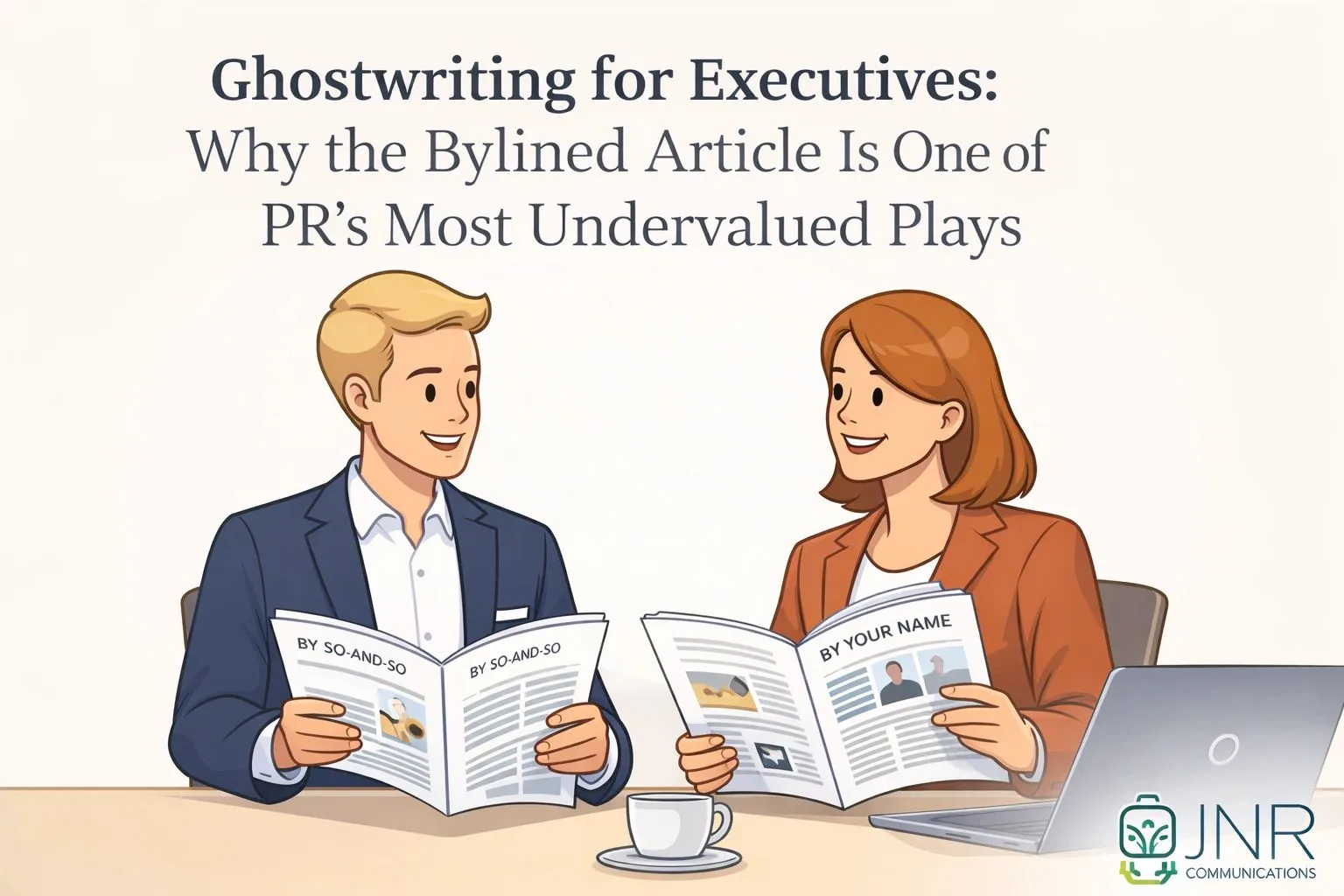
A bylined article is a piece of expert content published under a named executive's byline in a trade publication, industry journal, or consumer media outlet. Think of the columns you read in any number of vertical publications relevant to your industry.
These are not press releases. They are not paid advertisements. They are editorial content, written from an expert's point of view, that editors actively seek out because their readers want perspective from people who actually work in the field.
When your CEO, Medical Director, or founder's name appears on an article in a publication your ideal clients and referral partners are already reading, something important happens. They do not think, 'That company placed a story.' They think, 'That person knows what they are talking about.'
That is the authority transfer that no press release, Instagram post, or sponsored content unit can replicate.
Why Most Executives Never Do This
In my experience working across healthcare technology, business development, and PR, I have found that the gap between what executives know and what they publish comes down to three consistent barriers.
1. 'I Don't Have Time to Write'
This is the most honest objection. Executives are running businesses. They are not sitting at a desk waiting for a column deadline. The idea of carving out two to four hours to produce a polished 800-word article feels impossible on a Tuesday afternoon between patient consultations and vendor calls.
This is precisely why ghostwriting exists. A skilled PR and content team captures your thinking through a focused 30-minute conversation and does the rest. Your ideas, your voice, your byline. The writing is handled by someone else.
2. 'I Don't Know What to Write About'
Most executives underestimate how much they know that their audience wants to learn. The questions patients ask at the consultation. The industry misconceptions you correct every week. The technology shifts you are tracking. The results that surprise even experienced practitioners.
What feels obvious to you because you live it every day is genuinely valuable to editors and readers who do not. Part of our job at JNR Communications is helping executives identify those insights and frame them in a way that editorial audiences find compelling.
3. 'I Don't Think a Publication Would Want It'
This one surprises people the most when I challenge it. Trade and specialty publications are actively looking for expert contributors. Editors are not sitting on a surplus of qualified practitioners who want to share real clinical perspective or business insight. They have pages to fill and audiences to serve.
The key is knowing which publications are the right fit, understanding what their editors actually want, and having the relationships to make the right introduction. That is where an experienced PR partner becomes invaluable.
What Makes a Byline Actually Land
Not all bylined articles are created equal. I have seen plenty of executive columns that read like slightly dressed-up sales brochures. Editors reject those quickly, and rightly so. Here is what separates a byline that builds real credibility from one that gets passed over.
• Genuine perspective, not product promotion. The piece needs to offer a real point of view. Not 'here is why our treatment is great,' but 'here is what practitioners are getting wrong about patient recovery expectations.' Editors want expertise. Readers want insight. Give them both.
• Specificity over generality. Vague articles about 'the importance of patient experience' go nowhere. Specific articles grounded in real data, clinical observations, or concrete business frameworks earn placement and get shared.
• Audience alignment. A column about non-invasive body contouring trends belongs in MedEsthetics, not a general business journal. Understanding where your ideal client is reading is as important as understanding what to say.
• A headline that earns the click. Editors and readers decide in seconds. Your headline needs to signal that the article delivers something worth their time. This is both craft and strategy.
• Relationship-based placement. At JNR Communications, my partner Jennifer Rice has spent nearly 30 years building editorial relationships with major publications. Those relationships are not a shortcut around quality. But they mean the right article reaches the right editor's attention.
The Compounding Value of Byline Strategy
One of the concepts I find myself returning to again and again, both from my networking experience and my time studying relationship-based business cultures, is the idea that real authority compounds. One bylined article is valuable. A sustained byline strategy is transformative.
Here is what a consistent program typically builds over 12 to 18 months:
• A body of published work that prospective clients find when they search your name
• Speaking invitations that follow from publication credibility
• Media interview requests, because journalists often pitch experts they have already read
• Referral conversations that become much easier when a colleague can say 'I read that piece you published in New Beauty'
• Recruitment and partnership conversations elevated by visible thought leadership
The byline is the asset. Everything else is downstream of it.
How JNR Communications Makes This Work
Our approach to executive ghostwriting and byline placement is built on three things that most boutique PR firms cannot offer together.
First, editorial relationship access. Jennifer's nearly three decades of media relationships mean we understand what specific editors at specific publications are looking for right now. Not six months ago. Now.
Second, deep vertical expertise. We specialize in medical aesthetics, beauty, wellness, and medical device industries. We understand the regulatory nuances, the clinical credibility requirements, and the editorial standards of the publications that matter most to your clients and peers.
Third, voice capture that actually sounds like you. The goal of ghostwriting is not to produce generic expert content. It is to translate your specific perspective and experience into editorial prose that represents you accurately and compellingly. Our process starts with listening before we ever start writing.
We handle the pitch, the placement conversation, the editing rounds, and the final submission. You review and approve. When your name appears in print, it genuinely reflects your thinking.
A Note on Authenticity and Ghostwriting
Some executives feel uncertain about ghostwriting because it feels like taking credit for someone else's work. I understand that instinct. But consider what ghostwriting actually is in practice.
The ideas come from you. The expertise is yours. The clinical experience, the business philosophy, the insight that makes the article worth reading, all of that originates with the executive. The ghostwriter's job is to be a skilled translator: capturing those ideas accurately and shaping them into prose that meets editorial standards.
Ghostwriting has a long and legitimate history. Speechwriters, communications teams, and editorial collaborators have supported executives, politicians, and public figures for as long as there have been public figures. What matters is that the content is genuinely representative of the person whose name is on it.
When we write for an executive at JNR Communications, we do not fabricate positions or invent expertise. We amplify what is already there.
Starting Small: Your First Byline
You do not need to commit to a twelve-article editorial calendar to test whether this works for your business. The most effective starting point is usually a single, well-chosen placement.
We typically begin with an audit of your executive's expertise areas, a conversation about your target audience and the publications they read, and a review of editorial opportunities in your vertical. From there, we develop a focused pitch and a content brief.
For many of our clients in the medical aesthetics and beauty industries, the first placed byline produces results that convert them into consistent contributors. Once you see the kind of authority a well-placed article builds, the question shifts from 'should we do this?' to 'how do we do more?'
Ready to Put Your Expertise in Print?
At JNR Communications, we've helped executives in medical aesthetics, beauty, wellness, and medical device industries turn their expertise into published bylines that build real authority. Jennifer Rice's nearly 30 years of relationships with editors at major media and trade publications means we know how to position your voice where it matters most. Let's build your thought leadership platform together.
Contact us: Greg@JNRcommunications.com | JNRcommunications.com
About the Author
Greg Kaufman is a Partner at JNR Communications, where he focuses on social media strategy and business networking. His background spans healthcare technology, international business development, and strategic relationship building. Connect with him on LinkedIn.