Over the years, I've sat across from a lot of founders who tell me the same thing: we tried PR and it didn't work. When I start asking questions, a pattern emerges almost every time. It wasn't that PR failed them. It was that they approached it in a way that was almost guaranteed to disappoint.
In my experience building relationships across healthcare technology, international business, and professional networking, I've come to see PR the same way I see networking. It's infrastructure. It's long term. And when it breaks down, it usually breaks down for the same three reasons.
Let me walk you through them, because once you see them, you can't unsee them.
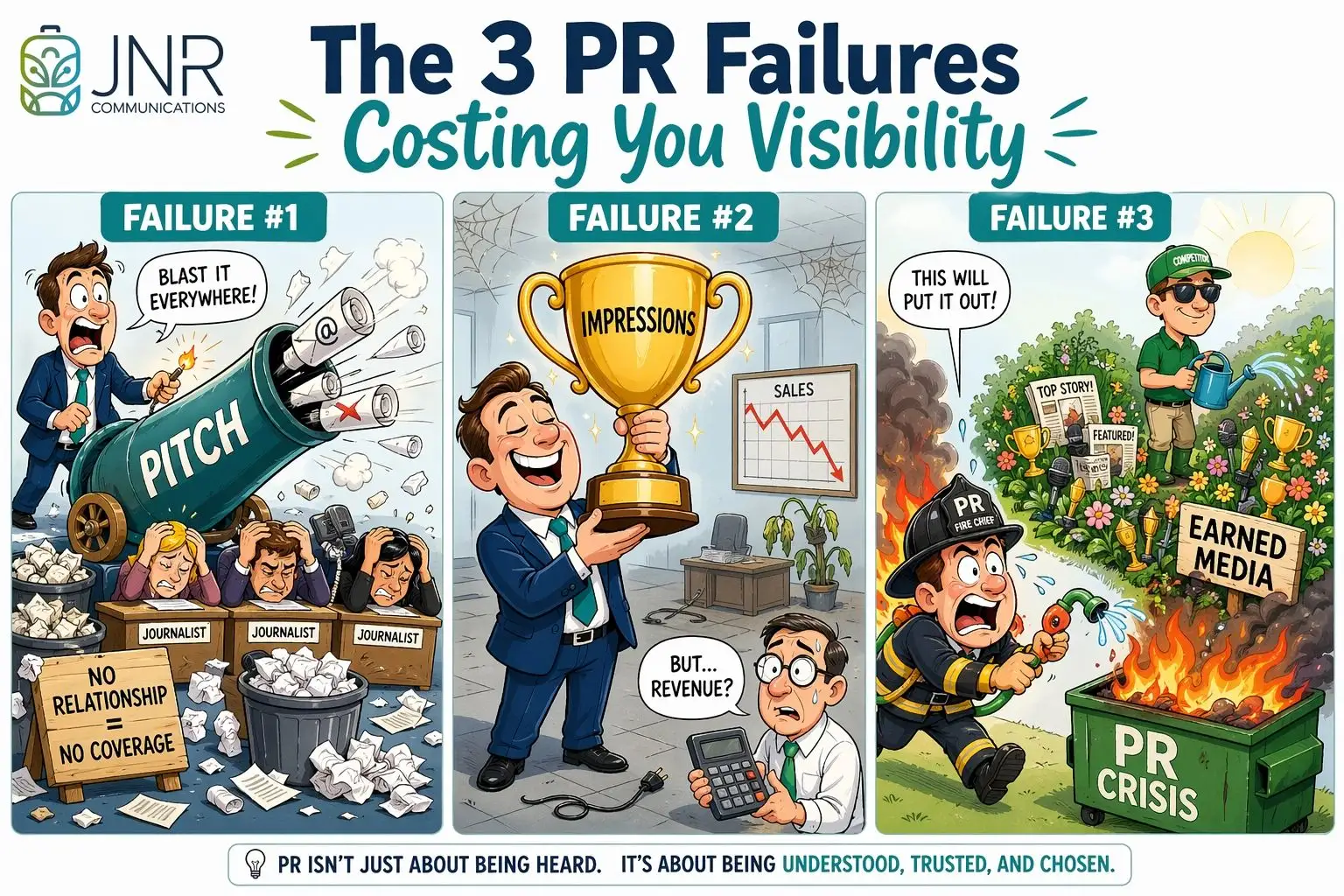
Failure #1: No Relationship Infrastructure Before the Pitch
Most businesses treat PR like a transaction. They pull a media list, write a pitch, blast it out to a hundred journalists, and wait for the phone to ring. When nothing happens, they conclude PR is broken.
Here's what's actually happening. Journalists receive dozens, sometimes hundreds, of pitches every week. They have limited time and unlimited inbound noise. When they're deciding what to cover, they gravitate toward people they already know, trust, or who come recommended by someone they trust.
This is the Givers Gain principle I learned through years of professional networking. You invest in the relationship before you need something from it. You offer value first. You show up consistently. You make introductions. You share insights. And when the day comes that you have something worth pitching, the journalist on the other end knows who you are, respects your perspective, and actually opens your email.
Cold pitching without a relationship foundation is like walking into a networking event, introducing yourself to a stranger, and immediately asking for a referral. It almost never works, and when it does, it's the exception that proves the rule.
WHAT TO DO INSTEAD
Start building your relationship infrastructure now, before you need coverage. Follow relevant journalists on LinkedIn and engage with their work genuinely. Share their articles when they resonate. Offer expert commentary when they're reporting on something in your space. By the time you have a story worth pitching, you're not a stranger. You're a familiar name with earned credibility.
Failure #2: Chasing Vanity Metrics Instead of Business Outcomes
I'll never forget the founder who proudly showed me a PR report full of impressive numbers. Millions of impressions. Dozens of placements. A follower count that had doubled in six months. He was paying his agency a substantial retainer, and the reports looked fantastic.
Then I asked the question that mattered: is any of this moving the needle on your business? Silence.
This is one of the most expensive failures in PR, and it happens because impressions and clip counts are easy to measure. Business outcomes are harder. So reports fill up with activity metrics that look impressive on paper but have almost no correlation with what actually matters: qualified leads, shorter sales cycles, stronger referral flows, and credibility with the audiences that drive revenue.
In medical aesthetics, beauty, and wellness, this matters enormously. A placement in a trade publication read by your referral partners can be worth more than ten placements in general consumer outlets. A single thoughtful feature that positions your founder as a category authority can drive business for years. But if you're measuring by raw impression count, you'll miss it entirely.
WHAT TO DO INSTEAD
Before you start any PR effort, define what success actually looks like in business terms. Are you trying to shorten your sales cycle? Attract better talent? Open doors with specific referral sources? Support a capital raise? Every tactic should ladder up to one of those goals, and every report should tell you whether you're getting closer, not just whether you're staying busy.
Failure #3: Running PR Reactively Instead of Continuously
The third failure is the one I find most avoidable. So many businesses only think about PR when something is already happening. A product launch. A crisis. A slow sales quarter. A competitor getting press and looking great while they look invisible.
By the time you need PR, it's too late to build it.
I think about this the same way I think about networking. If you only show up to events when you need a job, or only call your contacts when you need a favor, people notice. The relationship never compounds. You're constantly starting over.
Earned media works the same way. Every article, every podcast appearance, every thoughtful quote in a trade publication adds another layer to the reputation you're building. Google searches return more results about you. Prospects find you before you find them. Referral partners have something to point to. Journalists remember your name the next time they need a source.
But this only works if you're in motion continuously. A one-time push, followed by six months of silence, followed by another one-time push, never builds the compounding effect. You need to be visible consistently, which means having a strategy that runs in the background whether or not you have something urgent to announce.
WHAT TO DO INSTEAD
Treat PR as an always-on function, not a seasonal campaign. Keep your voice in the market every month. Develop a bench of story angles that flex with the news cycle. Build relationships with five or ten journalists who cover your space, and stay in touch with them even when you have nothing to sell. By the time you do have big news, you've already earned the right to be heard.
Why These Three Failures Travel Together
Here's the thing. These failures rarely show up alone. A business that cold-pitches journalists without relationships almost always measures success by vanity metrics, because that's all they have to point to. And a business that measures vanity metrics usually runs PR reactively, because they never built the strategic foundation that continuous investment requires.
Fix one, and the others get easier. Build genuine relationships with journalists, and your metrics start pointing toward real business outcomes because you're getting placements that matter. Shift from reactive to continuous, and you naturally start building the relationships that make pitching work in the first place.
The common thread is something I believe deeply after years in networking and business development: PR is a long game played through relationships. Not through transactions. Not through volume. Not through clever one-time campaigns. Through the patient, consistent work of showing up, providing value, and building trust with the people who influence your audience.
The good news is that you can start today. Pick one journalist whose work you respect and engage with their content genuinely. Sit down and define what business outcome you actually want from PR. Sketch out a twelve-month plan instead of a three-month sprint. Small, deliberate moves now create the infrastructure that makes everything else work later.
READY TO BUILD PR THAT ACTUALLY COMPOUNDS?
At JNR Communications, we combine Jennifer Rice's nearly 30 years of media relationships with a strategic, relationship-first approach to help brands in medical aesthetics, beauty, wellness, and medical devices earn visibility that drives real business outcomes. If you're ready to stop running into the same three failures and start building something that pays off for years, we'd love to talk.
✉ Greg@JNRcommunications.com / 🌐 JNRcommunications.com