When a prospect says you are too expensive, they usually mean they are not yet sure you are worth the risk. Here is how to close that gap without discounting.
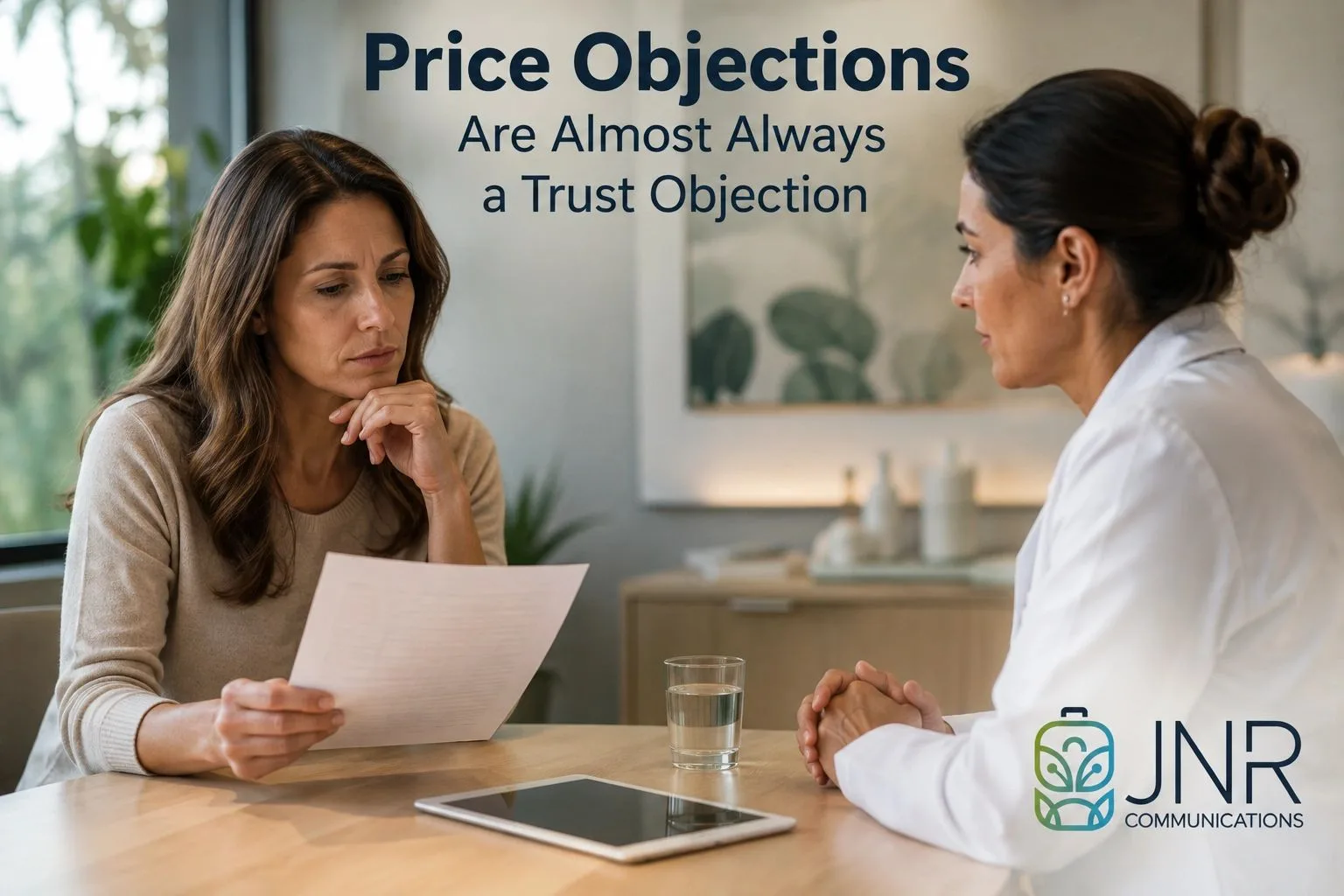
I sat in on a consultation a while back for a practice doing genuinely excellent work. Beautiful space, skilled provider, results that spoke for themselves. The consult went well. The prospective patient was engaged, asked good questions, nodded in the right places.
Then came the number.
She paused, smiled politely, and said the sentence every business owner has heard: "That is a little more than I was expecting. Let me think about it." She never came back.
The practice owner's read was that they were priced too high for the market. My read was different. That patient was not comparing the price to a competitor's price. She was comparing it to the possibility of spending real money and being disappointed. Nothing in her experience up to that point had removed that possibility.
That is the thing I have come to believe after decades of selling, training, and building relationships across industries: when someone tells you the price is too high, they are almost never talking about the number. They are telling you they are not yet convinced the outcome is certain enough to justify it.
The Real Math Your Prospect Is Doing
Think about the last significant purchase you made from someone you did not know. A contractor, a specialist, a consultant. You were not calculating whether the price was fair in the abstract. You were calculating risk.
What if it does not work. What if I do not like the result. What if this person is not as good as they seem. What if I look foolish for choosing them.
Price is simply the place where that anxiety becomes speakable. "It is too expensive" is a socially acceptable way to say "I am not sure about you," and almost nobody says the second sentence out loud.
Which means most businesses respond to the wrong objection. They hear a number problem and reach for a number solution.
Why Discounting Makes It Worse
I understand the reflex. The prospect is right in front of you, the moment feels like it is slipping, and a discount is the only lever you can pull immediately.
But look at what a discount actually communicates.
It says the original price was not real, which quietly raises the question of what else about your presentation was not real. It says the value was negotiable, which means it was never anchored to anything solid. And it does nothing at all about the underlying doubt, so you now have a prospect who is still unsure, just unsure at a lower margin.
Worse, discounting attracts the exact clients you least want. People who buy on price leave on price. The moment someone down the street runs a promotion, they are gone, and they were never going to refer you to anyone anyway.
The businesses I have watched command premium pricing year after year are not the cheapest and they are rarely the best marketers. They are the most trusted. That is the whole difference.
Trust Gets Built Long Before the Price Conversation
Here is the part that reframes everything. By the time you are quoting a number, it is almost too late to build trust. You are trying to construct a foundation while standing on it.
Everything that makes a price feel reasonable happens earlier, in the weeks and months before that person ever contacts you. It happens while they are reading, searching, scrolling, and asking friends.
Four proof assets do that work, and each one belongs in a specific place.
1. Third-party validation, placed where people research you. An article in a respected publication, an award, a quote as an expert source. You cannot say you are credible about yourself and have it land. Someone else saying it carries weight that self-promotion never will. This belongs on your website, in your email signature, in your consult materials, and anywhere a prospect goes to check you out. One good placement, kept visible, works for years.
2. Specific outcomes from people who look like them. Not "our clients love us." A real story with a real starting point, a real concern, and a real result. Reviews that describe a situation are ten times more persuasive than reviews that describe a feeling. This belongs on your site, in your follow-up emails, and in the hands of whoever answers your phone.
3. A visible human being. People do not trust businesses. They trust people. The provider or owner who shows up consistently, explains things clearly, and is recognizable as a person is doing trust work every single time. This is what social media is genuinely good for, and it is why a broadcasting feed underperforms a personal one.
4. A referral from someone they already trust. The most powerful of the four, and the one with the shortest price conversation attached. When a friend or another professional sends someone to you, most of the risk assessment is already complete. This is why relationship infrastructure matters so much. Referred prospects rarely flinch at the number, because trust arrived before the quote did.
What to Say When You Get the Objection Anyway
You will still hear it, and you should not panic when you do. Do not defend the price and do not drop it. Ask a question that gets to the actual concern.
"When you say it is more than you expected, is it the investment itself, or is it not being certain about the result?"
That question is not a sales trick. It is a genuine attempt to find out what is really in the way, and it works because it gives people permission to say the thing they were being polite about.
If it is truly budget, you can talk about timing, phasing, or a different starting point, honestly and without discounting your work.
If it is uncertainty, and it usually is, you now know exactly which proof to offer: the case that resembles theirs, the article, the person who will vouch for you. That is a conversation you can win.
How JNR Communications Helps
This is precisely the work we do, and it is why we approach PR as a business investment rather than a visibility exercise.
Jennifer Rice has spent nearly 30 years building relationships with editors and producers, and those relationships are how our clients earn the third-party validation that no ad budget can manufacture. Placements in respected outlets, award submissions that get taken seriously, expert positioning that puts our clients in the story rather than next to it. That is asset number one, built properly.
On my side, we work on the layers that surround it. Social media designed to make the human visible instead of broadcasting into silence. Content that tells specific stories rather than making general claims. And the relationship infrastructure that produces referrals, which is the layer most businesses in medical aesthetics, beauty, and wellness leave entirely to chance.
The outcome we are after is simple. By the time a prospective client reaches your consult, they should already know who you are, already have seen proof from someone other than you, and already trust the outcome. The price conversation gets much shorter when that groundwork is in place.
What You Can Do This Week
Pull your last ten lost opportunities and ask an honest question about each one: did that person have real evidence to trust us before they saw a price, or were we asking them to take our word for it?
Then look at what a prospect encounters in the seven days before they contact you. If everything they find is you talking about yourself, you have a proof gap, not a pricing problem.
Fix the proof and you will find that your prices were fine all along.
Building genuine connections takes time, but it is the foundation of PR that actually works. At JNR Communications, we combine Jennifer's nearly 30 years of media relationships with my strategic networking expertise to help businesses in CPG brands, beauty, wellness, and medical aesthetics achieve visibility that generates real results. Let's talk about your goals.
✉️ Greg@JNRcommunications.com