There is a moment every PR professional remembers. You craft a perfectly formatted press release, upload it to the wire service, hit send, and then wait. And wait. And wait. The phone does not ring. The inbox stays quiet. The coverage never comes.
If that story sounds familiar, you are not alone, and it is not because your news was not good enough. It is because the press release, as the centerpiece of a PR strategy, has fundamentally changed in how it must be deployed to achieve results. The way earned media actually gets secured today looks almost nothing like the playbook from ten or fifteen years ago.
In my work at JNR Communications, and across my background in healthcare technology and international business, I have watched the rules shift in real time. The agencies and businesses that are winning earned media coverage right now are doing something very different from what most people were taught. Let me walk you through what has changed and, more importantly, what to do about it.
The Wire Service Was Never the Relationship
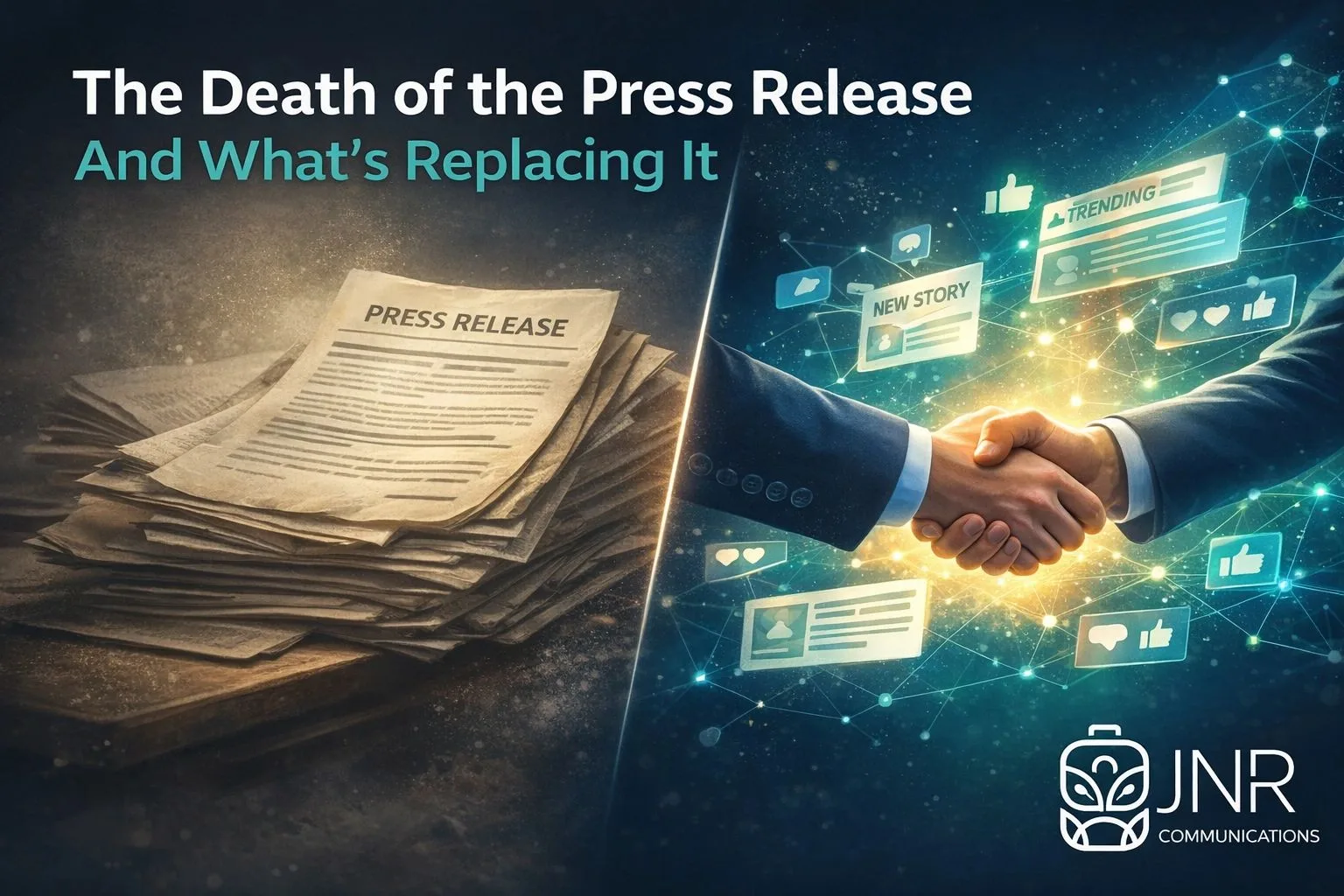
Let me be direct about something the PR industry has been slow to admit: the traditional press release sent over a wire distribution service was never really a media relations strategy. It was a broadcast mechanism. You were essentially shouting into a crowd and hoping the right person heard you.
Journalists today are more pressed for time than ever. The editorial staffs at major consumer publications have contracted significantly over the past decade, while the volume of pitches hitting their inboxes has exploded. A wire-distributed release competes with hundreds of other releases on the same day. A journalist scrolling through that feed is not looking for a story. They are looking for a reason to stop scrolling.
Here is what I learned from years of building relationships in professional networking and from studying the dynamics of trust in Japanese business culture during my time at Nagoya University: people do not make decisions based on broadcasts. They make decisions based on trust, context, and relevance. A press release distributed to everyone, everywhere, is the opposite of trust-based communication.
What the Data Is Actually Telling Us
The shift is not anecdotal. Editorial teams at top-tier publications receive thousands of pitches weekly. A significant majority of journalists report that personalized pitches are more likely to result in coverage. The outlets that matter most to your brand, whether that is Good Housekeeping, New Beauty Magazine, or a leading trade publication in your industry, are staffed by editors who have relationships with the sources they trust.
Those relationships are built before a pitch ever arrives. That is not a coincidence. It is a strategy.
Wire distribution still plays a role. It can support SEO through syndication, establish a public record, and reach niche trade outlets that monitor feeds in your sector. But it is a complement to a relationship-driven strategy, not the foundation of one. If you are leading with wire distribution, you are putting the cart before the horse.
The Storytelling-First Pitch: What It Looks Like
The pitch that actually works today reads nothing like a press release. It is short, personal, and story-first. It opens with a human insight, a trend observation, or a specific detail that signals the sender has actually read the publication they are pitching.
At JNR Communications, Jennifer Rice has spent nearly 30 years cultivating editorial relationships with major publications. What makes her pitches land is not that she has a better press release template. It is that she understands the editorial perspective deeply enough to present stories the way an editor at that specific publication is already thinking about them.
Here is what a storytelling-first pitch includes:
• A human angle that connects to a trend the outlet is already tracking
• Evidence that you know this specific publication and reader
• A short, compelling narrative hook in the first two sentences
• A clear articulation of why this story matters right now
• Expert sources, data, or visuals that make the journalist's job easier
What it does not include is a boilerplate introduction, three paragraphs of company background, or a list of product features. Those elements might belong in a backgrounder document, but they do not belong in the pitch itself.
Why Relationship Infrastructure Matters More Than Tactics
Here is the insight that most PR conversations miss. The best pitch in the world underperforms when there is no relationship behind it. Conversely, a decent story becomes a great coverage opportunity when the person presenting it is already known and trusted by the editor.
I think about this as relationship infrastructure. Just as a building needs load-bearing walls before you can add floors, a PR strategy needs load-bearing relationships before individual pitches can carry weight. You build that infrastructure through consistent, genuine engagement over time, not through transactional outreach when you need something.
This principle applies directly to the medical aesthetics and beauty brands we work with at JNR. A medspa or a dermatology practice that has invested in building its reputation and visibility over time, through thought leadership, authentic content, and genuine media engagement, occupies a fundamentally different position than one that surfaces only when launching a new treatment.
Editors remember who shows up when there is nothing to sell. They also remember who only appears when there is something to promote.
The New Toolkit: What Has Actually Replaced the Old Press Release
So if wire-first distribution is no longer the centerpiece, what is? Here is how the most effective earned media strategies are structured today:
• Personalized narrative pitches to a curated, relevant media list built on genuine relationships
• Expert positioning through thought leadership content that makes you a go-to source
• Proactive trend monitoring so your story arrives when editorial interest is already building
• Visual assets and data that reduce the friction between pitch and publication
• Consistent presence and engagement that keeps your brand warm in a journalist's awareness
• Strategic wire distribution as amplification of coverage already secured, not as a first step
This is not a checklist you complete once. It is an ongoing practice. The brands that earn consistent media coverage are not the ones that are best at writing press releases. They are the ones that have made themselves genuinely useful to journalists and editors over time.
How JNR Communications Approaches This Differently
Our agency's approach is built on the exact premise that relationships come first. Jennifer's nearly three decades of cultivated editorial relationships are not contacts in a database. They are genuine professional connections developed through years of delivering reliable, relevant stories.
When we pitch on behalf of a client in medical aesthetics, beauty, or wellness, we are drawing on a foundation of trust that took decades to build. That trust does not come from a press release. It comes from a track record of understanding what an editor needs and delivering it consistently.
For clients entering the market or working to build media visibility, we focus first on building the infrastructure: identifying the right media relationships, developing authentic story angles, and positioning their expertise in a way that makes journalists want to call them. We use wire distribution strategically, as amplification and record-keeping, not as a primary pitch vehicle.
The result is coverage that actually moves the needle for a business, placements in publications their target audience reads and trusts, rather than syndicated placements on websites no one visits.
What You Can Do Starting Today
Whether you are managing PR internally or working with an agency, here are three concrete steps to shift toward a storytelling-first, relationship-driven approach:
• Audit your last five pitches. How much of each was about your company? How much was about the story the journalist's audience would care about? Reverse that ratio.
• Identify three publications that matter most to your business and spend time truly studying them. Read multiple issues. Understand their angle, their tone, their recurring themes. A pitch that speaks their language gets read. A generic pitch does not.
• Start building relationships before you have news to share. Comment on journalists' work. Offer perspective when they are researching a story. Be useful without an agenda. That is how you build the trust that makes your next pitch land.
The press release is not dead as a document. It is still a useful reference tool and a formal record of announcements. But as a media relations strategy, leading with it is like starting a conversation by handing someone your business card. It might tell them who you are, but it does not give them a reason to care.
The story does that. The relationship makes them listen.
Ready to build earned media coverage that actually works?
JNR Communications combines Jennifer Rice's nearly 30 years of media relationships with strategic storytelling expertise to help medical aesthetics, beauty, and wellness brands secure coverage that builds real visibility. Let's talk about your goals.
Email: Greg@JNRcommunications.com | Website: JNRcommunications.com