By Greg Kaufman, Partner | JNR Communications | April 2025You earned it. A journalist wrote about your brand. Your product got featured in a trade publication. A local news segment spotlighted your practice. That is a real win, and it deserves real celebration.But here is what I see happen constantly: businesses post the link once on social media, maybe send a quick email to their list, and then move on. Two days later, that earned media win is buried under new content and forgotten.That is leaving enormous value on the table. In my years helping businesses build their PR and communications strategies, I have come to think of media placements the way a good investor thinks about assets. A single placement is not a one-time transaction. It is a compounding asset that can generate returns for weeks if you know how to work it.Let me walk you through the repurposing system we use at JNR Communications to help clients stretch a single earned media win into a full 30 days of marketing content. This works whether you are a medical aesthetics practice, a wellness brand, a law firm, a technology company, or really any business that has invested in PR.Why Most Businesses Underuse Their Media CoverageBefore we get into the playbook, it is worth understanding why this happens. Most business owners think of media coverage as news. News is fresh for a day or two, then it is stale. That framing causes people to treat a feature article the way they treat a news headline.But earned media is not news. It is credibility. And credibility does not expire.A feature in a respected trade publication tells your prospects, your referral partners, your existing clients, and your future employees something that no ad can communicate: someone outside your own organization decided you were worth writing about. That signal is valuable every single time someone encounters it, whether that is today or six months from now.When my partner Jennifer Rice secures a placement for a client in an outlet, we do not just hand over the link and call it done. We help clients build a content engine around it. Here is how.Days 1 to 3: Announce and AmplifyThe first 72 hours after a placement goes live are your highest-velocity window. Your audience is more receptive to announcement-style content right now, and the freshness of the news gives you permission to be direct. Your Week 1 Action ListDay 1 - Post the link across all active social channels with a genuine, first-person captionDay 1 - Send a dedicated email to your full list announcing the featureDay 2 - Share the article in relevant LinkedIn groups and industry communitiesDay 2 - Notify referral partners directly so they can share with their networksDay 3 - Add the outlet logo and a quote from the article to your website homepage or media pageThat referral partner step matters more than most people realize. In my networking experience through BNI, I have seen how one person sharing a win can ripple through an entire professional community. Your partners want to celebrate your success, and their audience is full of your future clients. Give them something easy to share.Days 4 to 10: Go Deeper on SocialBy day four, your initial announcement has run its course. Now it is time to extract the ideas inside the article and turn them into standalone social content. This is where most businesses stop, and where you should just be getting started.Pull out three to five specific insights, quotes, or data points from the article. Each one becomes its own social post, formatted natively for each platform. You are not reposting the article. You are sharing the value inside it. 30-Day Content Repurposing FrameworkDays 1-3: Announce across social, email, and partner networksDays 4-10: Extract insights for standalone social postsDays 11-17: Email sequence and sales collateral integrationDays 18-24: Website + pitch deck upgradesDays 25-30: Wrap-up campaign and retrospective contentFor LinkedIn specifically, think about the angle that will resonate with your professional audience. If a dermatology trade journal wrote about your clinic's patient experience approach, that insight works beautifully as a LinkedIn post about building trust in healthcare. You are adding context and perspective, not just recycling a headline.For Instagram or Facebook, pull a compelling quote or visual detail from the article and pair it with a strong image. The article is the authority. Your commentary is the connection.Days 11 to 17: Email Sequence and Sales CollateralYour email list is full of people who have already opted in to hear from you. A media placement gives you a genuine reason to reach out, not once, but multiple times over the course of a week.Here is a simple three-email sequence that works:• Email 1 (Day 11): The announcement email for anyone who missed your initial send. Subject line: 'We were just featured in [Publication Name].' Keep it short and link directly to the article.• Email 2 (Day 13): The insights email. Pull one key idea from the article and expand on it. Tie it back to a problem your audience is actively trying to solve. No direct sales pitch. Just value.• Email 3 (Day 15): The CTA email. Share a client success story that echoes the theme of the article, then invite readers to connect for a conversation.On the sales collateral side, your media placement should immediately become part of your pitch materials. Add it to:• Your email signature as a linked badge or text callout• Your new client welcome packet• Your one-sheet or agency overview document• Your proposals and scopes of workThis is what I mean when I talk about relationship infrastructure. Every touchpoint where a prospect or referral partner encounters your name is an opportunity to reinforce your credibility. A media placement multiplies that credibility across every single touchpoint, if you put it there intentionally.Days 18 to 24: Upgrade Your Website and Pitch DeckBy week three, many businesses have moved on to the next thing. This is exactly when you should be doing your most strategic work with the placement.Your website should reflect your media wins prominently. If you do not have a dedicated press or media page, now is the time to create one. A simple page listing your notable features, with outlet logos and brief pull quotes, communicates authority to every visitor who lands on your site, whether they are a prospective client, a reporter researching your company, or a potential partnership. Website Integration ChecklistAdd outlet logo to your media page or homepage credibility barPull a strong quote from the article and display it as a testimonialWrite a brief summary of the feature for your blog with a link to the full articleUpdate your About page bio to include the placementAdd the placement to your speaker or expert profile if applicableYour pitch deck gets the same treatment. A single slide dedicated to media coverage, with recognizable outlet logos and brief context, does more for your perceived authority than three slides of service descriptions. I have seen this shift the tone of sales conversations completely. When a prospect sees that credible outside sources have validated your work, the dynamic of the meeting changes.Days 25 to 30: Close the Loop and Look AheadThe final week of your 30-day system is about two things: wrapping up the campaign with intentionality and using the momentum to set up your next PR opportunity.Write a short retrospective post for LinkedIn or your blog. Reflect on what the article was about, what response you received, and what it means for the work you are doing. This type of authentic, behind-the-scenes content performs exceptionally well because it humanizes your brand and invites engagement.Then take stock of what the placement opened up. Did any journalists reach out? Did referral partners mention it? Did you close any new business where the article came up in conversation? These data points matter.At JNR, we help clients track not just the placement itself, but the downstream effects of repurposing it well. Sometimes the value of a media win shows up weeks after the article published, in an email from a prospect who found your website, saw the coverage, and decided to reach out.How JNR Communications Makes This Happen for YouExecuting this kind of 30-day repurposing system takes planning, consistency, and creative bandwidth that most businesses do not have sitting on the bench. That is where we come in.Jennifer's nearly 30 years of media relationships mean we are not just securing placements in respected outlets. We are building the kind of ongoing media presence that gives you a steady stream of content to work with. And because we understand content strategy alongside PR, we can help you build the repurposing engine so every win keeps compounding.Whether you run a medical aesthetics practice, a wellness brand, a professional services firm, a manufacturing company, or a consumer-facing business, the principle is the same. Earned media is an asset. The question is whether you are treating it like one.The businesses that win in the long run are not necessarily the ones who get the most media coverage. They are the ones who do the most with the coverage they earn. Ready to make your media coverage work harder?At JNR Communications, we combine Jennifer's nearly 30 years of media relationships with a strategic approach to content repurposing that keeps your earned media wins generating real business results long after publication day. Let's talk about building your relationship infrastructure together.Greg@JNRcommunications.com | JNRcommunications.com About the AuthorGreg Kaufman is a Partner at JNR Communications, a Las Vegas-based PR agency specializing in medical aesthetics, beauty, and wellness industries. With decades of experience in healthcare technology education, international business development, and professional networking, Greg brings a unique relationship-focused perspective to PR and social media strategy. He believes that the most effective communications begin with genuine connection and that relationship infrastructure is the foundation of sustainable business growth.rn One Media Placement into 30 Days of Content
You earned it. A journalist wrote about your brand. Your product got featured in a trade publication. A local news segment spotlighted your practice. That is a real win, and it deserves real celebration.
But here is what I see happen constantly: businesses post the link once on social media, maybe send a quick email to their list, and then move on. Two days later, that earned media win is buried under new content and forgotten.
That is leaving enormous value on the table. In my years helping businesses build their PR and communications strategies, I have come to think of media placements the way a good investor thinks about assets. A single placement is not a one-time transaction. It is a compounding asset that can generate returns for weeks if you know how to work it.
Let me walk you through the repurposing system we use at JNR Communications to help clients stretch a single earned media win into a full 30 days of marketing content. This works whether you are a medical aesthetics practice, a wellness brand, a law firm, a technology company, or really any business that has invested in PR.
Why Most Businesses Underuse Their Media Coverage
Before we get into the playbook, it is worth understanding why this happens. Most business owners think of media coverage as news. News is fresh for a day or two, then it is stale. That framing causes people to treat a feature article the way they treat a news headline.
But earned media is not news. It is credibility. And credibility does not expire.
A feature in a respected trade publication tells your prospects, your referral partners, your existing clients, and your future employees something that no ad can communicate: someone outside your own organization decided you were worth writing about. That signal is valuable every single time someone encounters it, whether that is today or six months from now.
When my partner Jennifer Rice secures a placement for a client in an outlet, we do not just hand over the link and call it done. We help clients build a content engine around it. Here is how.
Days 1 to 3: Announce and Amplify
The first 72 hours after a placement goes live are your highest-velocity window. Your audience is more receptive to announcement-style content right now, and the freshness of the news gives you permission to be direct.
Your Week 1 Action List
Day 1 - Post the link across all active social channels with a genuine, first-person caption
Day 1 - Send a dedicated email to your full list announcing the feature
Day 2 - Share the article in relevant LinkedIn groups and industry communities
Day 2 - Notify referral partners directly so they can share with their networks
Day 3 - Add the outlet logo and a quote from the article to your website homepage or media page
That referral partner step matters more than most people realize. In my networking experience through BNI, I have seen how one person sharing a win can ripple through an entire professional community. Your partners want to celebrate your success, and their audience is full of your future clients. Give them something easy to share.
Days 4 to 10: Go Deeper on Social
By day four, your initial announcement has run its course. Now it is time to extract the ideas inside the article and turn them into standalone social content. This is where most businesses stop, and where you should just be getting started.
Pull out three to five specific insights, quotes, or data points from the article. Each one becomes its own social post, formatted natively for each platform. You are not reposting the article. You are sharing the value inside it.
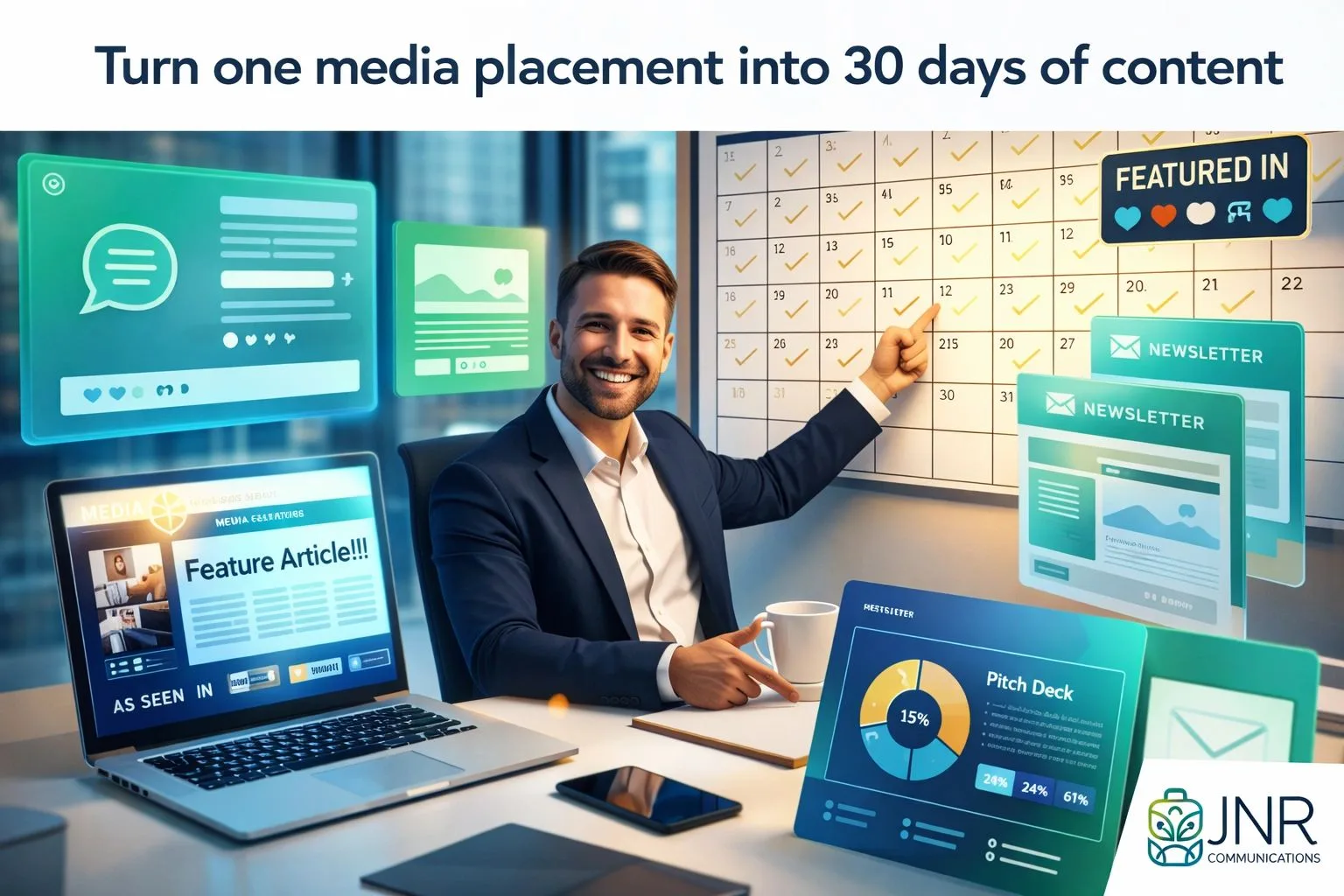
30-Day Content Repurposing Framework
Days 1-3: Announce across social, email, and partner networks
Days 4-10: Extract insights for standalone social posts
Days 11-17: Email sequence and sales collateral integration
Days 18-24: Website + pitch deck upgrades
Days 25-30: Wrap-up campaign and retrospective content
For LinkedIn specifically, think about the angle that will resonate with your professional audience. If a dermatology trade journal wrote about your clinic's patient experience approach, that insight works beautifully as a LinkedIn post about building trust in healthcare. You are adding context and perspective, not just recycling a headline.
For Instagram or Facebook, pull a compelling quote or visual detail from the article and pair it with a strong image. The article is the authority. Your commentary is the connection.
Days 11 to 17: Email Sequence and Sales Collateral
Your email list is full of people who have already opted in to hear from you. A media placement gives you a genuine reason to reach out, not once, but multiple times over the course of a week.
Here is a simple three-email sequence that works:
• Email 1 (Day 11): The announcement email for anyone who missed your initial send. Subject line: 'We were just featured in [Publication Name].' Keep it short and link directly to the article.
• Email 2 (Day 13): The insights email. Pull one key idea from the article and expand on it. Tie it back to a problem your audience is actively trying to solve. No direct sales pitch. Just value.
• Email 3 (Day 15): The CTA email. Share a client success story that echoes the theme of the article, then invite readers to connect for a conversation.
On the sales collateral side, your media placement should immediately become part of your pitch materials. Add it to:
• Your email signature as a linked badge or text callout
• Your new client welcome packet
• Your one-sheet or agency overview document
• Your proposals and scopes of work
This is what I mean when I talk about relationship infrastructure. Every touchpoint where a prospect or referral partner encounters your name is an opportunity to reinforce your credibility. A media placement multiplies that credibility across every single touchpoint, if you put it there intentionally.
Days 18 to 24: Upgrade Your Website and Pitch Deck
By week three, many businesses have moved on to the next thing. This is exactly when you should be doing your most strategic work with the placement.
Your website should reflect your media wins prominently. If you do not have a dedicated press or media page, now is the time to create one. A simple page listing your notable features, with outlet logos and brief pull quotes, communicates authority to every visitor who lands on your site, whether they are a prospective client, a reporter researching your company, or a potential partnership.
Website Integration Checklist
- Add outlet logo to your media page or homepage credibility bar
- Pull a strong quote from the article and display it as a testimonial
- Write a brief summary of the feature for your blog with a link to the full article
- Update your About page bio to include the placement
- Add the placement to your speaker or expert profile if applicable
- Your pitch deck gets the same treatment. A single slide dedicated to media coverage, with recognizable outlet logos and brief context, does more for your perceived authority than three slides of service descriptions. I have seen this shift the tone of sales conversations completely. When a prospect sees that credible outside sources have validated your work, the dynamic of the meeting changes.
Days 25 to 30: Close the Loop and Look Ahead
The final week of your 30-day system is about two things: wrapping up the campaign with intentionality and using the momentum to set up your next PR opportunity.
Write a short retrospective post for LinkedIn or your blog. Reflect on what the article was about, what response you received, and what it means for the work you are doing. This type of authentic, behind-the-scenes content performs exceptionally well because it humanizes your brand and invites engagement.
Then take stock of what the placement opened up. Did any journalists reach out? Did referral partners mention it? Did you close any new business where the article came up in conversation? These data points matter.
At JNR, we help clients track not just the placement itself, but the downstream effects of repurposing it well. Sometimes the value of a media win shows up weeks after the article published, in an email from a prospect who found your website, saw the coverage, and decided to reach out.
How JNR Communications Makes This Happen for You
Executing this kind of 30-day repurposing system takes planning, consistency, and creative bandwidth that most businesses do not have sitting on the bench. That is where we come in.
Jennifer's nearly 30 years of media relationships mean we are not just securing placements in respected outlets. We are building the kind of ongoing media presence that gives you a steady stream of content to work with. And because we understand content strategy alongside PR, we can help you build the repurposing engine so every win keeps compounding.
Whether you run a medical aesthetics practice, a wellness brand, a professional services firm, a manufacturing company, or a consumer-facing business, the principle is the same. Earned media is an asset. The question is whether you are treating it like one.
The businesses that win in the long run are not necessarily the ones who get the most media coverage. They are the ones who do the most with the coverage they earn.
Ready to make your media coverage work harder?
At JNR Communications, we combine Jennifer's nearly 30 years of media relationships with a strategic approach to content repurposing that keeps your earned media wins generating real business results long after publication day. Let's talk about building your relationship infrastructure together.
Greg@JNRcommunications.com | JNRcommunications.com
About the Author
Greg Kaufman is a Partner at JNR Communications, a Las Vegas-based PR agency specializing in medical aesthetics, beauty, and wellness industries. With decades of experience in healthcare technology education, international business development, and professional networking, Greg brings a unique relationship-focused perspective to PR and social media strategy. He believes that the most effective communications begin with genuine connection and that relationship infrastructure is the foundation of sustainable business growth.