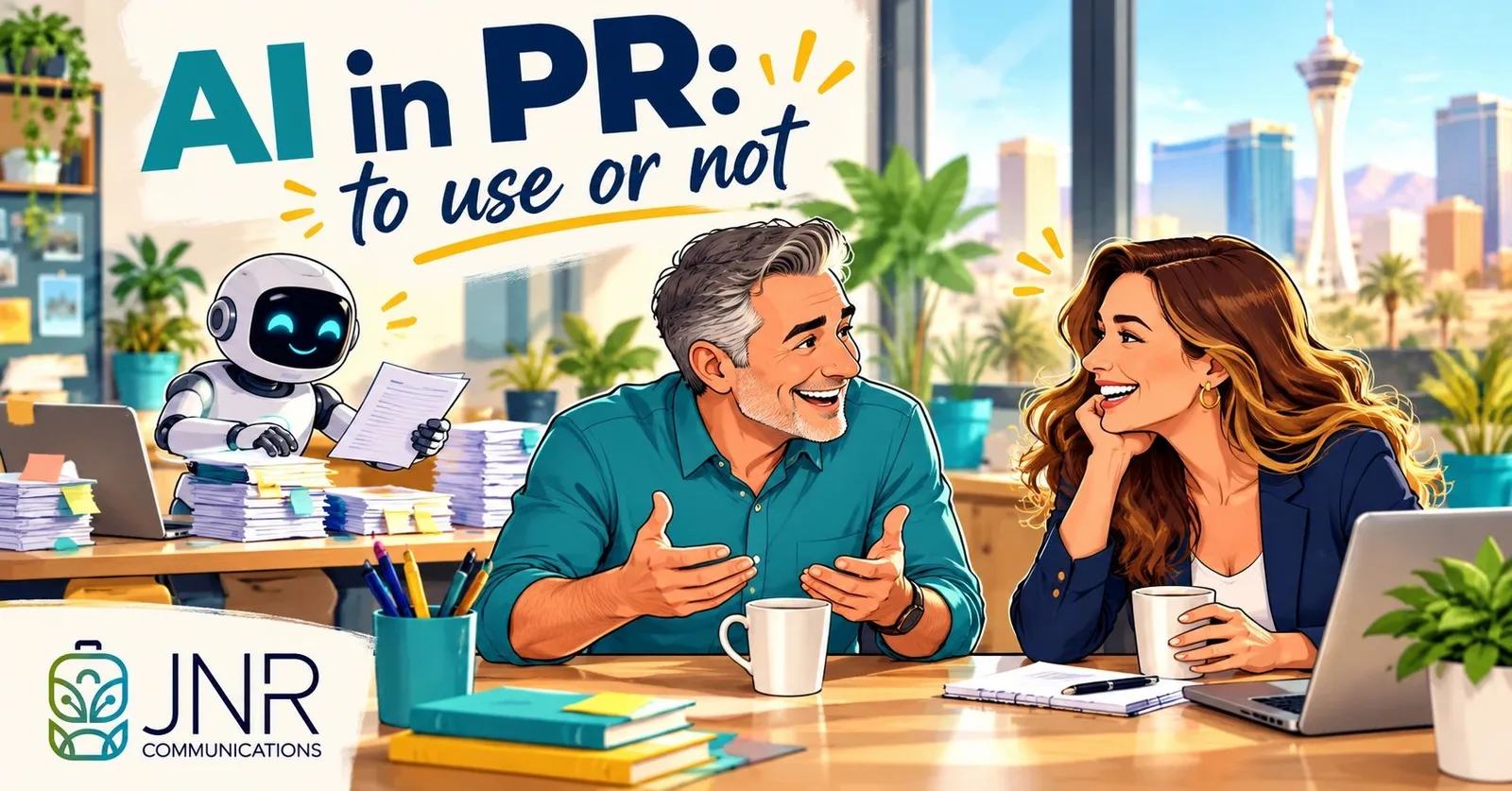
Every week someone asks me a version of the same question. "Should we be using AI for our marketing?" Usually they ask it with a little guilt, as if they are confessing something.
My answer is always the same. You probably already are. The better question is whether you are using it in the right places.
I spent years in healthcare technology, designing training programs for enterprise systems rolled out across hospitals. One lesson from that work has stayed with me: the technology was never the hard part. The hard part was deciding what the tool should do, what people should still do, and how to keep trust intact while everything changed. AI in PR, marketing, and social media is the same story on a faster clock.
Where AI stands in PR and marketing today
The adoption debate is over. Muck Rack's State of AI in PR 2026 report, which surveyed 564 PR professionals, found that 76 percent use generative AI and 75 percent pay for at least one AI tool, up from 57 percent the year before. About half now work somewhere with a formal AI use policy, compared with roughly one in five in 2024.
Notice what has not taken off. Only 12 percent of AI users rely on AI agents that act on their own, and 90 percent said they would be more comfortable with agents if a human had to approve the work first.
I find that encouraging. The professionals using AI most are also the ones insisting a person stays in the loop. I agree with them.
The positive side: where AI genuinely helps
Let's give credit where it is earned. Used well, AI makes good communicators faster and frees up time for the work that actually builds relationships.
Research and preparation. AI can summarize a reporter's recent coverage, scan industry news, and pull together background on a trend in minutes. That used to eat an afternoon.
First drafts and repurposing. A blank page is expensive. AI is very good at producing a rough starting point, or at turning one strong blog post into an email, three social captions, and a short video script.
Social media brainstorming. When a medspa needs a month of content ideas, AI can generate a long list quickly. A human then picks the five that actually sound like that practice.
Editing and clarity. It catches awkward sentences, tightens long paragraphs, and flags jargon a patient would never understand.
Listening at scale. AI tools help monitor reviews, comments, and mentions, so you spot a pattern (a recurring question, a frustrated client, a rising topic) before it becomes a problem.
Visual concepts. Image generators let small businesses test creative ideas without a full photo shoot.
There is one more positive most people miss, and it matters a great deal to our clients. Muck Rack's Generative Pulse research, which analyzed more than 25 million links, found that 84 percent of the citations in ChatGPT, Claude, and Gemini answers come from earned media. When a prospective patient asks an AI assistant who the best injector in town is, the answer leans heavily on what credible third parties have said about you. AI did not make PR less important. It made earned media the input layer for how people discover you.
Concerns, warnings, and cautions
Now the honest part. Here is what I watch for, and what I encourage every business owner to watch for too.
1. Accuracy is not guaranteed. AI can state wrong information with total confidence, including invented statistics, sources, and quotes. Every fact needs a human check before it goes out under your name.
2. Your voice can disappear. When everyone uses the same tools with the same prompts, everything starts to sound the same. Polished but generic content is easy to scroll past, and it builds no trust.
3. Privacy and confidentiality. In the same Muck Rack report, 77 percent of PR pros said they avoid entering financial data into AI, and 69 percent avoid personal information or proprietary materials. Good instinct. For medical aesthetics and healthcare clients, patient information never goes into a public AI tool.
4. Regulated claims. Medical device, aesthetic, and wellness marketing carries real compliance risk. AI does not know your FDA clearances or what your attorney approved, and it will happily write a claim you cannot legally make.
5. Fake authenticity. AI written reviews, testimonials, or "customer" comments are not a gray area. The FTC finalized a rule banning fake reviews in 2024, including ones generated by AI, and last December the agency sent warning letters to ten companies about possible violations. Getting caught destroys trust far faster than it was built.
6. Spam at scale. AI makes it easy to send hundreds of "personalized" pitches or LinkedIn messages. Journalists and prospects can tell. Volume was never the constraint in PR. Trust was.
7. Skills that never develop. More than three in four PR pros in the Muck Rack survey worry that heavy AI use could keep younger practitioners from learning the fundamentals. I share that concern. You cannot judge a draft if you never learned to write one.
8. Transparency. If AI played a meaningful role, especially in images that look like real people or real results, be upfront about it. In aesthetics, before and after photos must be real. Always.
What Japan taught me about tools and trust
During my years at Nagoya University, I learned the concept of nemawashi, carefully preparing the roots before you move a tree. In Japanese business, decisions are rarely made in the meeting. They are made in the quiet conversations beforehand, where trust is built one person at a time.
No tool can do nemawashi for you. AI can help you prepare for a conversation. It cannot have the conversation. It can draft the thank you note, but it cannot remember that your referral partner's daughter just started college and that a quick congratulations would mean more than any pitch.
That is the dividing line I use. AI handles the preparation. People handle the relationship.
How JNR Communications uses AI
Clients deserve to know how their agency works, so here is our approach.
Where we use it:
- Research, background briefs, and media landscape scans
- Rough outlines and maybe first drafts that a person then rewrites
- Repurposing approved content across platforms
- Brainstorming angles, headlines, and social content calendars
- Summarizing meeting notes and transcripts
- Concepting images for blogs and social posts
Where we do not:
- Writing media pitches. Jennifer Rice's nearly 30 years of media relationships were built one genuine conversation at a time, and we will NEVER automate that.
- Entering confidential client data or any patient information into public tools
- Creating reviews, testimonials, or quotes
- Publishing anything without human review for accuracy, compliance, and voice
Think of AI as a very fast research assistant. Useful, tireless, and never the one who signs off.
What you can do this week
- Write a one page AI policy. List what your team can use AI for, what is off limits, and who reviews before anything publishes.
- Run the two column test. On the left, tasks where speed matters and judgment does not. On the right, tasks that carry trust. Only the left column goes to AI.
- Ask AI about yourself. Type "who is the best [your service] in [your city]" into a few AI assistants. See who shows up and which sources get cited. That is your earned media gap, made visible.
- Reinvest the time you save. If AI saves you five hours a week, spend one of them on real relationships: coffee with a referral partner, a helpful note to a journalist, a genuine reply to a client's comment. Givers Gain still works. AI simply gives you more time to practice it.
The bottom line
AI is the most useful assistant our industry has ever had. It is also the easiest way to sound like everyone else.
The businesses that win will not be the ones producing the most content. They will be the ones using AI to clear away the busywork so they can show up more often, and more personally, for the people who matter. Technology changes fast. How people decide whom to trust has not changed at all.