If your competitor could paste your About page onto their site and nobody would notice, that is a business problem. Here is the fix. I have a game I play when I cannot sleep. I open the About page of a business I have never heard of and try to guess what they actually do before I get to the third paragraph. I lose more often than you would think.
Here is a real composite, stitched together from pages I have read this year. See if you can name the industry.
"Founded on a passion for excellence, we are a family owned company dedicated to delivering unparalleled service. Our team of experienced professionals is committed to quality, integrity, and putting the customer first. We combine state of the art technology with old fashioned values to exceed your expectations, every single time."
Medspa? Roofing company? Accounting firm? Dental practice? Pet grooming?
Yes. All of them. That paragraph (or similar) is currently live on approximately nine thousand websites and it has never once caused a human being to pick up a phone.
I am not making fun of the people who wrote it. I have written versions of it myself, usually late on a Thursday when the site had to go live Friday and specificity felt risky. Almost every business drifts into this language the same way, one safe phrase at a time. But it is worth naming what it costs, because the cost is real and it shows up in your pipeline.
The Swap Test
Here is the only test you need, and it takes four minutes.
Open your About page. Copy any sentence about who you are. Now imagine pasting it onto your closest competitor's website.
Would anyone notice? Would anything be untrue?
If the answer is no and no, you have not written positioning. You have written a description of your industry, and you have paid a web designer to display it in a nice font.
I did this with a client last spring. Aesthetics practice, good clinicians, genuinely excellent outcomes. We put their homepage copy side by side with the two practices they lose bids to most often. Same words. Not similar. Same. Three businesses competing hard against each other had independently arrived at identical sentences, and every one of them believed those sentences described something distinctive.
When everything sounds the same, buyers fall back to the only variable left, which is price or proximity. That is not because your buyers are shallow. It is because you did not hand them anything else to compare.
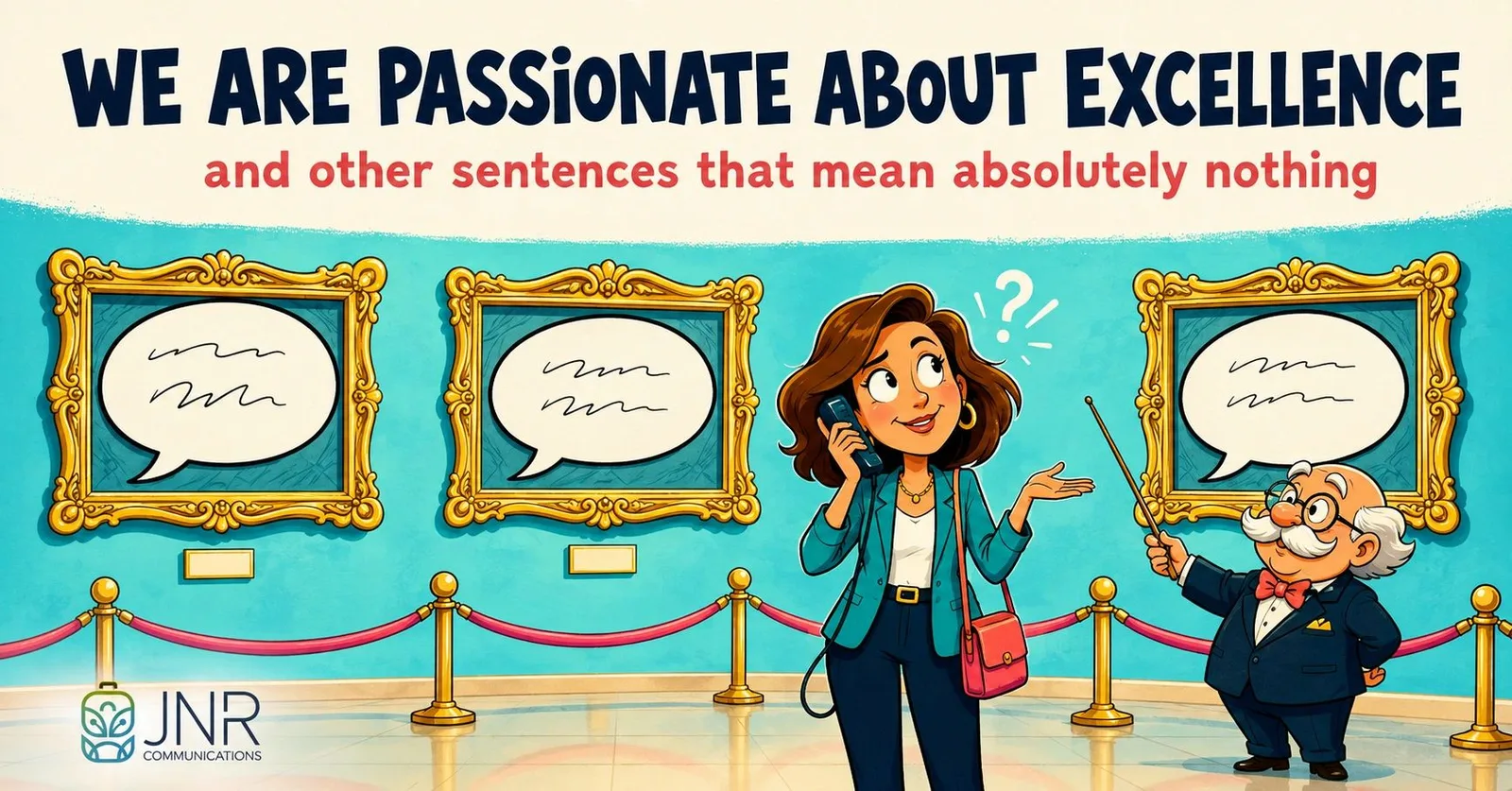
The Museum of Meaningless Phrases
Let me take you through the permanent collection. Every one of these is on a website right now, possibly yours.
"We are passionate about what we do." Translation: we hope you assume we are not phoning it in. Nobody has ever written "we are mildly interested in what we do," so the word carries no information at all.
"Committed to quality." As opposed to the competitors openly committed to shoddiness. This is the marketing equivalent of a restaurant advertising that the food is not poisonous.
"State of the art." Usually written about equipment purchased in 2019. Name the device instead. The name means something to the people who are shopping seriously.
"Family owned and operated." This one at least contains a fact. The trouble is that in most local categories, so is every competitor, which turns a true statement into background noise.
"Your satisfaction is our top priority." If it were, this sentence would be replaced by what happens when I am not satisfied.
"We go above and beyond." Above and beyond what? This phrase points at a specific story and then declines to tell it.
"Experienced professionals you can trust." Trust is not a claim you get to make about yourself. It is a verdict other people reach about you. Announcing it is a little like walking into a room and telling everyone you are humble.
"We treat every client like family." Depending on the family, this is either lovely or a genuine threat.
The through line is that every phrase in this museum is unfalsifiable. There is no way to fail at being passionate. There is no way to check "committed to quality" before you hand over a credit card. And anything a buyer cannot check, a buyer discounts.
Why Smart People Write This Way
This is not a talent problem. I have watched sharp, specific, funny business owners describe their work brilliantly across a table and then approve website copy that sounds like a hostage statement.
Three things cause it.
Specificity feels like exposure. The moment you write "we call every patient the evening after a procedure," you have created something you can be caught not doing. Vague language is safe precisely because it promises nothing. That safety is also why it persuades nobody.
Everyone is copying upward. Owners look at the biggest brand in their category, borrow the tone, and miss that the big brand's copy works only because everyone already knows who they are. Vague language is a luxury good. You can afford it after you are famous, not before.
Nobody wants to exclude anyone. The instinct is to write copy that appeals to every possible customer, which reliably produces copy that grabs none of them. This is the single most expensive instinct in small business marketing.
Three Replacements That Fix Almost Everything
You do not need a rebrand or a copywriter. You need to run three swaps.
1. Replace the adjective with a number, a name, or a rule.
"We are responsive" becomes "we answer the phone with a human being from 7am to 6pm, and you get a callback the same day if you reach us after that."
"Highly experienced team" becomes "our lead injector has performed more than four thousand treatments and trains other providers on the device."
"State of the art technology" becomes the actual name of the actual machine.
Notice these are not better businesses. They are the same business, described in a way a stranger can evaluate. That is the whole trick.
2. Replace the claim about yourself with evidence from someone else.
You saying you are trusted is decoration. A named client result, a review that describes a specific moment, a placement in a publication your buyer already reads, an award with a real vetting process behind it. All of these say the same thing you were trying to say, except a third party is saying it, which is the only version anyone believes.
This is the part of the job where earned media stops being abstract. Jennifer has spent nearly thirty years building the relationships that turn a business's actual substance into third-party validation, and the reason that work matters is exactly this. There is a ceiling on what you can claim about yourself. There is no ceiling on what someone credible can say about you.
3. Replace "for everyone" with "and here is who we are not for."
The bravest line on any website is the one that turns somebody away. "If you want the lowest price in town, we are probably not your best fit" does more work than a page of superlatives, because it proves you have a point of view and it tells the right buyer they found their people.
Every time I have talked a client into a line like that, two things happened. Fewer leads, and a dramatically higher percentage of them closing. That trade is almost always worth making.
The Referral Reason This Matters More Than Your Website
Here is the part people underestimate, and it comes straight from years in referral rooms.
Nobody can refer a business they cannot describe.
If your positioning is "we are passionate about excellence," your happiest client has nothing to repeat. When their friend asks for a recommendation, the best they can do is "they were great," which is roughly as persuasive as no answer at all.
But if your positioning is "they lock the price before they start and they text you the day after," your client has a story. Stories travel. Adjectives do not.
Specific language is not just a conversion tool. It is the script you are handing to every person who wants to send you business and currently cannot find the words.
A Test
Open your About page. Highlight every sentence a competitor could honestly say word for word. For most businesses, almost the entire page lights up.
Whatever survives is your real differentiation. Now go write three more sentences that could only be true of you, using a number, a name, or a rule. Put them at the top, where the passion paragraph used to be.
Then read it out loud. If it sounds like something you would actually say to a person across a table, you got it right.
Excellence is not a message. It is the thing you demonstrate after somebody chooses you, which they will only do if you gave them a reason that was not available to everyone else in your category.
Your network determines your results in PR. JNR Communications brings deep media relationships and strategic networking expertise to help specialized businesses achieve the visibility they deserve. Let's build your relationship infrastructure together.
📞 (818)357-7286 | ✉️ Greg@JNRcommunications.com