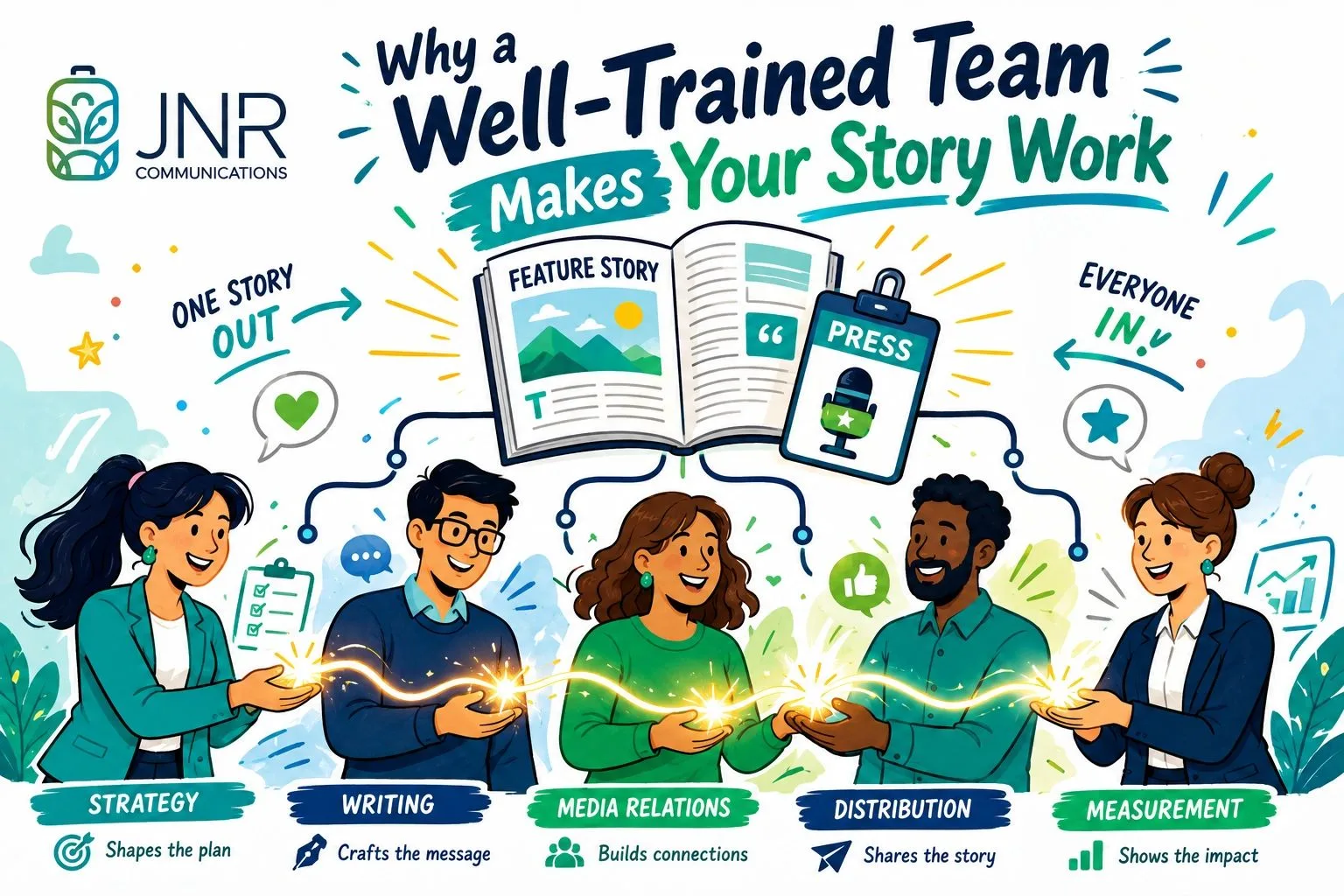
Your PR story is only as strong as the people who live it every day. The placement is the spark. Your team decides whether it catches fire.
The Story Does Not End at the Press Release. It Begins There.
Here is a scenario I have watched play out more times than I can count. A business invests in PR. The agency does excellent work. A great story runs. The phone starts ringing, website traffic spikes, and new prospects show up curious and ready to engage.
And then they meet the team. The person answering the phone has no idea the feature ran and cannot speak to what made it special. The provider quoted in the article fumbles the very expertise that got them attention. The social media coordinator never amplifies the placement because nobody told them it existed. The momentum that took months to build evaporates in a week.
This is the gap that quietly kills PR results. The story lives in the media. The experience lives with your team. When those two things do not match, prospects feel the disconnect immediately, and trust erodes before a relationship ever has a chance to form.
What Enterprise Training Taught Me About Brand Stories
During my years in healthcare technology, my job was essentially to close gaps exactly like that one. We did not hand clients a new system and wish them luck. We built the education layer that turned a piece of software into something a busy clinical team could actually use under pressure. That discipline taught me three things that translate directly to PR.
First, knowledge does not transfer by accident. People do not absorb your message simply because you published it somewhere. They need to be taught, given context, and shown how it applies to their specific role.
Second, consistency is a skill, not a personality trait. The reason some organizations deliver a seamless experience across dozens of touchpoints is not luck. It is that someone designed the training to make consistency the default rather than the exception.
Third, the people closest to the customer matter most. The executive who gives the interview gets the spotlight, but the receptionist, the nurse, the coordinator, and the technician are the ones who decide whether the promise in that interview actually feels real.
Every Person on Your Team Is Part of the Story
When we talk about PR, we tend to picture a spokesperson and a journalist. But your brand story is told far more often by people who will never appear in a single article.
Your story is told when someone calls and a team member answers with warmth and knowledge. It is told in the waiting room, in the follow-up email, and in the way a question gets handled when something goes wrong. Each of those moments either reinforces the story your PR created or quietly contradicts it.
I came to understand this clearly during my time as a researcher and lecturer in Japan, where I studied how trust and relationships are built across cultures. In relationship-based business cultures, nobody separates the message from the messenger. How you are treated is the message. The most carefully crafted story means nothing if the human experience behind it does not deliver. That is true everywhere, not just in Japan. We have simply gotten better at pretending otherwise.
Training Builds Consistency, and Consistency Builds Trust
Trust is the entire game in PR, especially in medical aesthetics, wellness, and healthcare, where people are making decisions about their bodies and their health. Trust is not built by a single great story. It is built by a hundred small, consistent confirmations that the story is true.
A well-trained team produces those confirmations naturally. They know the brand story. They understand why it matters. They can speak to it in their own words without sounding scripted. They know how to handle the hard questions, the awkward moments, and the unexpected media opportunity that walks through the door.
That kind of consistency is not an accident, and it is not free. It is the product of intentional education, and the good news is that it compounds. Every trained team member becomes a reliable node in what I call your relationship infrastructure, the web of genuine connections and consistent experiences that makes everything else in your marketing actually work.
How to Train Your Team to Support Your Story
You do not need an enterprise learning department to do this well. You need intention and a simple plan. Here is where I would start.
1. Make sure everyone knows the story. Before you can ask your team to support your PR, they need to know what it is. When a feature runs, share it internally. Explain what made the story newsworthy and what you want people to take away from it. You would be amazed how many teams have no idea their own company was just covered in the press.
2. Connect the story to each person's role. A brand story is abstract until someone can see how it shows up in their day. Help the front desk understand how they reinforce it on every call. Help your providers see that their expertise is the proof behind the story. When people understand their part, they own it.
3. Practice the moments that matter. The interactions that make or break trust are predictable. The first phone call. The pricing question. The complaint. Walk your team through these moments and let them practice. A little rehearsal turns anxiety into confidence.
4. Close the loop after every placement. When PR generates a result, tell your team. Show them the booking that came from the article or the prospect who mentioned the segment. When people see that their work connects to real outcomes, they engage with it differently.
5. Treat education as ongoing, not one and done. The most common training mistake I saw in healthcare technology was treating education as a one-time event. It is not. Stories evolve, teams change, and skills fade without reinforcement. Build small, regular touchpoints instead of one exhausting session that everyone forgets.
Your Team Is Your Most Underused Communications Asset
Here is the reframe I want to leave you with. Most businesses think of PR as something an agency does and a spokesperson delivers. The reality is that your entire team is a communications channel, every single day, whether you have trained them for it or not.
A well-educated team does not just protect the investment you make in PR. It multiplies it. Every confident, knowledgeable interaction extends the reach of your story far beyond what any single placement could achieve. That is the Givers Gain principle at work inside your own walls. When you invest in your people, giving them knowledge, context, and confidence, they give it back in the form of a brand experience that earns trust again and again.
The best PR strategy in the world cannot outrun a team that is not ready to support it. But a prepared, educated team can turn even a modest media win into a foundation for lasting growth.
Let's Build a Team That Brings Your Story to Life
Building genuine connections takes time, and so does building the kind of team that carries your story everywhere it travels. At JNR Communications, we combine Jennifer Rice's nearly 30 years of media relationships with strategic communications expertise to help businesses in medical aesthetics, beauty, and wellness, food earnv visibility that actually converts. If you are ready to make sure your team is prepared to support your PR, let's talk
✉ Greg@JNRcommunications.com 🌐 JNRcommunications.com